New Delhi, India – May 19, 2026
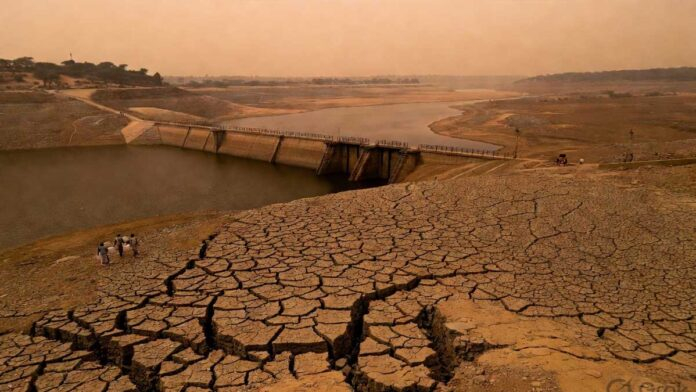
India is facing a growing water crisis as water levels in the country’s major reservoirs continue to decline rapidly amid extreme summer heat and fears of a weak monsoon season. According to the latest report released by the Central Water Commission (CWC), total storage in 166 major reservoirs across the country has dropped to just 34.45 percent of total capacity, raising concerns over drinking water supply, irrigation, and hydropower generation in the coming months.
The report highlights that 13 major reservoirs have already fallen below 50 percent storage capacity, while several dams in different states have reached critically low or near-zero levels. Southern and eastern India are among the worst-affected regions.
Water Storage Falls Sharply in Just Two Weeks
According to the CWC report, the total available water storage currently stands at 63.232 billion cubic meters (BCM). On April 30, the same reservoirs held 71.082 BCM of water, accounting for 38.72 percent of total capacity.
In just two weeks, nearly 8 BCM of water storage has declined, reflecting the growing pressure caused by extreme heat conditions and rising water demand.
Experts warn that if the southwest monsoon weakens due to El Niño conditions, India could face severe pressure on water resources during the peak summer months.
Reservoirs in Southern States Reach Critical Levels
Several reservoirs in Tamil Nadu, Kerala, Karnataka, and Telangana have reported water levels far below normal storage capacity.
- Tamil Nadu’s Vaigai Reservoir has only 12.47 percent water remaining.
- Aliyar Reservoir in Tamil Nadu is currently at 21.25 percent capacity.
- Kerala’s Periyar Dam has dropped to 41.65 percent.
- Karnataka’s Tattihalla Reservoir stands at 26.27 percent.
- Telangana’s Priyadarshini Jurala Dam has fallen to 39.49 percent.
The declining levels are raising concerns over irrigation needs, urban water supply, and hydroelectricity generation across southern India.
Several Dams Report Near-Zero Water Levels
The situation has worsened in parts of eastern and central India, where several reservoirs are nearing complete depletion.
- Bihar’s Chandan Dam has reached zero storage level.
- Maharashtra’s Bhima Ujjaini Reservoir is also completely dry.
- Uttar Pradesh’s Maudaha Reservoir has reported zero water availability.
Other reservoirs facing severe stress include:
- Assam’s Khandong Reservoir at 17.42 percent
- Madhya Pradesh’s Rajghat Dam at 35.05 percent
- Uttarakhand’s Tehri Dam at 20.85 percent
- West Bengal’s Kangsabati Reservoir at 31.50 percent
- Uttar Pradesh’s Matatila Reservoir at 40.58 percent
River Basins Also Witness Major Decline
The CWC report further revealed a sharp decline in storage levels across major river basins.
- Ganga Basin storage has dropped to 43.34 percent.
- Godavari Basin stands at 36.52 percent.
- Narmada Basin storage is currently 34.96 percent.
- Krishna Basin has emerged as one of the most critical regions, with only 19.31 percent water remaining.
- The Barak Basin in the Northeast remains below 20 percent capacity.
Water levels in the Brahmani-Baitarani, Cauvery, and east-flowing river basins between Mahanadi and Pennar are also running below normal levels.
El Niño Concerns Add to Worries
While the India Meteorological Department (IMD) has indicated the possibility of an early monsoon onset, concerns over El Niño conditions continue to worry experts.
El Niño refers to the warming of sea surface temperatures in the Pacific Ocean, a phenomenon that often weakens the Indian monsoon and leads to below-normal rainfall.
Climate experts say that a weak monsoon could intensify the ongoing water crisis and place additional pressure on agriculture, drinking water supply, and power generation.
Situation Could Worsen by End of May
The Central Water Commission has warned that reservoir levels could decline further if temperatures continue to rise and pre-monsoon rainfall remains insufficient.
States where reservoirs are already below half capacity are considered highly vulnerable. Experts believe that without adequate rainfall in the coming weeks, many regions may face severe challenges related to:
- Drinking water supply
- Agricultural irrigation
- Hydropower production
- Urban water management
Authorities are closely monitoring the evolving situation as India enters one of the most critical phases of the summer season.