
Washington, D.C. – May 19, 2026
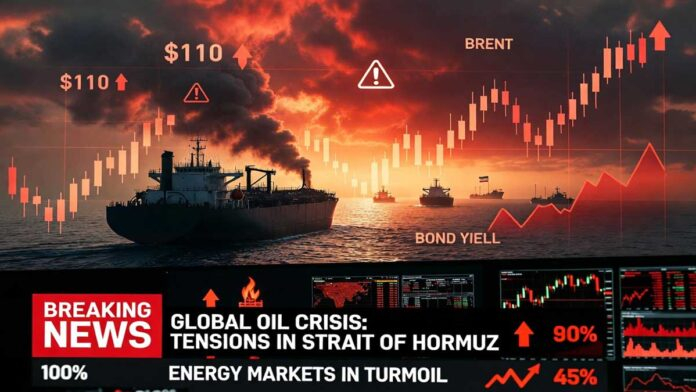
Global energy and financial markets witnessed renewed volatility on Monday after US President Donald Trump issued a fresh warning to Iran amid stalled ceasefire negotiations and continued disruption in the Strait of Hormuz.
The escalating geopolitical tensions pushed international crude oil prices sharply higher, while government bond yields in the United States, Japan, and Europe also climbed as investors worried about rising inflation and prolonged global economic uncertainty.
Oil Prices Jump as Hormuz Strait Remains Disrupted
According to reports, global benchmark Brent crude rose 1.7 percent to reach $111.13 per barrel, while US West Texas Intermediate (WTI) crude climbed 2.1 percent to $107.62 per barrel.
The sharp increase came as Iran continued restricting movement through the Strait of Hormuz following recent military tensions involving the United States and Israel.
The Strait of Hormuz remains one of the world’s most strategically important energy corridors, with nearly 20 percent of global oil shipments passing through the route.
Market analysts say any prolonged disruption in the region could severely impact global fuel supplies and increase transportation and manufacturing costs worldwide.
Trump Issues New Warning to Iran
President Donald Trump intensified pressure on Tehran through a social media statement, warning Iran that “nothing will remain” if the country fails to take immediate steps toward a resolution.
The remarks came at a time when ceasefire discussions between Washington and Tehran appear to have stalled.
Iranian media outlets claimed that the United States had not offered meaningful concessions in response to Tehran’s latest proposals, further complicating diplomatic efforts.
The latest developments have raised fears that the regional conflict could drag on longer than expected, increasing risks for global trade and energy markets.
Bond Yields Rise on Inflation Concerns
The surge in energy prices also triggered sharp movements in global financial markets, particularly in government bond markets.
Investors are increasingly concerned that higher oil prices could push inflation upward, forcing major central banks to maintain elevated interest rates or implement further rate hikes.
In the United States, the benchmark 10-year Treasury yield climbed to 4.63 percent, marking its highest level in more than a year. The yield reflects the borrowing cost of the US government over a 10-year period.
Higher bond yields typically indicate expectations of stronger inflation and tighter monetary policy.
Japan and Europe Also See Sharp Yield Increases
Japan’s government bond market also experienced significant pressure amid expectations of additional government spending to offset the economic impact of the ongoing conflict.
According to reports, Japanese authorities are preparing an additional budget package that may require fresh debt issuance.
The yield on Japan’s 30-year government bond surged to a record 4.2 percent, while the country’s 10-year bond yield rose to 2.8 percent for the first time since October 1996.
Government bond yields across the eurozone also moved higher as investors reassessed inflation and growth risks linked to the energy crisis.
Investors Fear Broader Economic Impact
Financial analysts warn that continued instability in the Middle East could increase pressure on global economies already struggling with inflation, supply chain disruptions, and slowing growth.
Rising crude oil prices may also lead to:
- Higher fuel and transportation costs
- Increased manufacturing expenses
- Persistent inflationary pressure
- Slower global economic recovery
Markets are now closely watching diplomatic developments between the United States and Iran, as any escalation or breakthrough could significantly influence global energy prices and financial stability in the coming weeks.