
Washington, D.C., United States — March 7, 2026
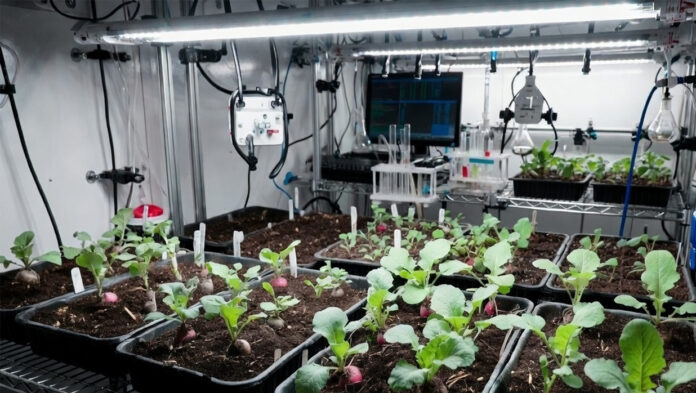
Recent research by NASA suggests that crops grown in lunar soil, known as regolith, could support future human missions to the Moon. In controlled experiments, scientists found that radishes grown in simulated Moon soil are safe to eat and contain nutrients similar to those grown on Earth.
The findings represent an important step toward developing sustainable food systems for astronauts during long-term space missions.
Why Scientists Chose Radishes
Researchers selected radishes for the experiment due to several advantages that make them suitable for space agriculture.
Fast Growth Cycle
Radishes mature in about 27 days, making them ideal for missions where quick crop cycles are necessary.
Low Maintenance
The plant requires relatively minimal care and limited space, important factors for controlled environments such as space stations or lunar habitats.
Genetic Similarity to Research Plants
Radishes share genetic similarities with Arabidopsis, a small flowering plant widely used in scientific research and often studied in space biology experiments.
Key Findings from the Research
According to NASA scientists, the experiment produced encouraging results for future lunar farming initiatives.
Safe and Nutritious Crops
Radishes grown in simulated lunar regolith and microgravity conditions were found to be safe for consumption and contained nutrients comparable to radishes grown on Earth.
Signs of Plant Stress
Genetic analysis using RNA sequencing showed that plants grown in simulated space conditions responded differently to environmental stress compared with those grown in Earth’s soil.
Improved Soil Fertility with Additives
Researchers also discovered that mixing vermicompost or beneficial bacteria with regolith significantly improved soil fertility and plant growth compared with pure lunar soil.
Farming on the Moon: Part of NASA’s Artemis Program
The findings are particularly relevant to NASA’s Artemis program, which aims to return astronauts to the Moon and establish a long-term human presence there.
During the planned Artemis III mission, currently targeted for the coming years, NASA intends to send an experimental system called LEAF (Lunar Effects on Agricultural Flora).
This instrument will study how radiation, reduced gravity, and lunar environmental conditions affect plant growth and photosynthesis directly on the Moon’s surface.
Expanding Lunar Agriculture Experiments
Beyond radishes, scientists have also successfully grown chickpeas in simulated lunar soil, demonstrating that a wider range of crops may eventually be cultivated beyond Earth.
Researchers believe such developments could lead to innovative food solutions for astronauts. For example, chickpeas grown in lunar conditions could potentially be used to create plant-based foods such as hummus during long-term missions.
A Step Toward Sustainable Space Exploration
Growing food on the Moon is considered a crucial element for deep-space exploration and long-duration missions. Transporting food from Earth for extended missions is expensive and logistically complex.
If crops can be reliably cultivated in lunar environments, astronauts could gain a renewable food supply, reducing mission costs and increasing sustainability for future lunar bases.
NASA scientists say continued research will focus on improving soil conditions, plant resilience, and agricultural systems that can function in the extreme environment of space.