Beijing, China — April 19, 2026
In a historic milestone for artificial intelligence and robotics, humanoid robots have, for the first time, outperformed human runners in an official half marathon, signaling rapid advancements in bipedal robotics.
During the Beijing Half Marathon on Sunday, dozens of Chinese-made humanoid robots competed alongside human participants, with several machines surpassing human performance over the 21.1-kilometer race.
Record-Breaking Performance
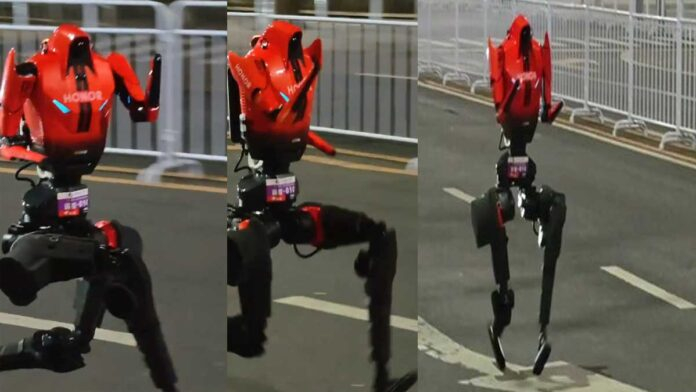
The standout performer, a robot named “Lightning,” developed by Honor, completed the race in just 50 minutes and 26 seconds—faster than the current human world record of 57 minutes and 20 seconds set by Jacob Kiplimo earlier this year.
Honor’s robots secured the top three positions in the race, highlighting a significant leap in robotic endurance and speed.
How the Race Was Conducted
To ensure safety, robots ran on parallel tracks alongside more than 100 human runners. Notably, nearly half of the machines operated fully autonomously without remote control, demonstrating advanced real-time navigation and balance capabilities.
While minor incidents occurred—such as one robot falling at the start and another colliding with a barrier—the overall performance impressed spectators and experts alike.
Technology Behind ‘Lightning’
The “Lightning” robot features advanced engineering designed to mimic elite human runners:
- Leg structures measuring approximately 90–95 cm for optimized stride efficiency
- Advanced liquid cooling systems adapted from smartphone technology
- High-performance AI for balance, pacing, and terrain adaptation
According to engineer Du Xiaodi, part of the development team, the project was completed in just one year and focuses on broader technological applications beyond racing.
Beyond Sports: Real-World Applications
Developers emphasized that the goal is not just speed but real-world usability. Improvements in structural reliability, cooling systems, and autonomous movement could soon translate into practical applications such as logistics, industrial automation, and caregiving.
Rapid Progress in Just One Year
The achievement marks a dramatic improvement from the previous year’s inaugural event, where the fastest robot took more than 2 hours and 40 minutes to complete the same distance.
Sunday’s results underscore the accelerating pace of innovation in humanoid robotics, particularly in China’s growing tech sector.
Public Reaction
Spectators expressed amazement at the rapid advancements. One attendee described the progress as “enormous,” noting that it was the first time robots had clearly surpassed human runners in such an event.
A Turning Point for Robotics
The Beijing race could represent a turning point in the evolution of humanoid robots. As machines continue to improve in mobility and autonomy, experts believe they may soon play a larger role in everyday human environments.