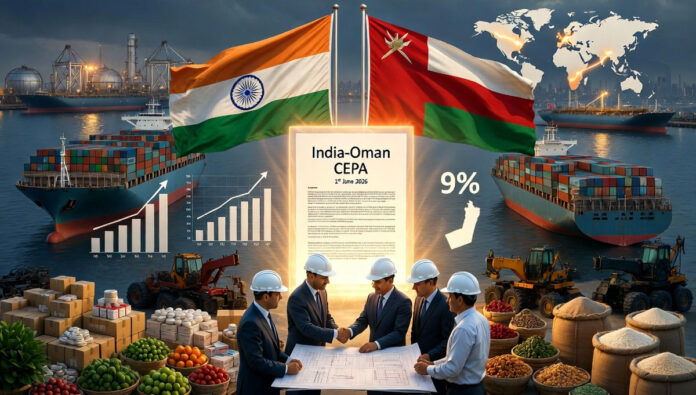
NEW DELHI, India — June 1, 2026
India-Oman CEPA Officially Comes Into Force, Opening a New Era of Trade and Economic Cooperation
India-Oman CEPA (Comprehensive Economic Partnership Agreement) officially came into effect on June 1, 2026, marking a significant milestone in economic relations between the two countries. The landmark trade agreement is expected to accelerate bilateral commerce, strengthen India’s energy security, expand export opportunities, and create new avenues for Indian professionals seeking opportunities in Oman.
The agreement is being viewed as one of India’s most strategically important trade deals in the Gulf region, particularly amid ongoing uncertainty surrounding energy supply routes in West Asia.
Signed on December 18, 2025, the Comprehensive Economic Partnership Agreement is expected to help double bilateral trade from the current level of approximately $10.61 billion to more than $20 billion in the coming years.
Fifth Major Free Trade Agreement Under the Modi Government
The India-Oman CEPA becomes the fifth major free trade agreement implemented during the tenure of Prime Minister Narendra Modi.
India has previously implemented similar trade agreements with Mauritius, United Arab Emirates, Australia, and the European Free Trade Association. Trade agreements with the United Kingdom and New Zealand have also been signed.
The Oman agreement is particularly important because it combines trade expansion with strategic energy cooperation.
More Than 98% of Indian Products Get Duty-Free Access
One of the biggest advantages of the agreement is that Indian exporters will gain duty-free access across more than 98% of Oman’s product categories.
The tariff concessions cover nearly 99% of the total trade value between the two countries, significantly improving the competitiveness of Indian products in the Omani market.
The agreement is expected to benefit exporters in sectors such as:
- Engineering goods
- Pharmaceuticals
- Agriculture and processed foods
- Marine products
- Textiles and garments
- Chemicals
- Electronics
- Machinery
- Plastics and rubber products
- Transport equipment
- Watches
- Gems and jewelry
- Paper products
Industry experts believe the elimination of tariffs will provide Indian manufacturers with greater market access and export opportunities across the Gulf region.
Major Benefits for Farmers and Food Exporters
The agreement also offers substantial advantages to India’s agricultural and food-processing sectors.
Products such as natural honey, cashew nuts, potatoes, boneless meat, and bakery products will receive duty-free entry into Oman.
Additionally, Oman will remove import duties on several food products that previously attracted tariffs ranging from 5% to 100%, including:
- Cheese
- Yogurt
- Milk and cream
- Frozen fish
- Butter
- Meat products
- Bread
- Pastries
- Cakes
- Chocolates
- Sugar products
The move is expected to create significant export opportunities for Indian food producers and farmers.
Stronger Energy Security for India
The agreement comes at a crucial time for India’s energy sector.
Growing uncertainty surrounding energy shipments through the Strait of Hormuz has highlighted the need for alternative and reliable supply channels. Oman has emerged as a key partner in ensuring uninterrupted energy flows to India.
A proposed 2,000-kilometer subsea pipeline connecting Oman and Gujarat is under consideration and could provide an alternative route for natural gas supplies in the future.
In recent months, Oman has also increased liquefied natural gas (LNG) supplies to India, helping offset disruptions affecting regional energy markets.
According to available data, Oman’s share of India’s LNG imports had risen significantly by May 2026, underlining the country’s growing importance in India’s energy strategy.
New Opportunities for Indian Professionals
For the first time, Oman has introduced dedicated provisions aimed at facilitating opportunities for Indian professionals.
The agreement is expected to benefit professionals working in:
- Information Technology (IT)
- Accounting
- Engineering
- Healthcare
- Education
- Construction
- Consulting Services
The new framework could allow Indian companies to deploy more skilled professionals to Oman while creating greater employment opportunities in the Gulf nation.
Lower-Cost Dates and Other Benefits for Indian Consumers
Indian consumers may also benefit directly from the agreement.
India has agreed to provide duty-free access for up to 2,000 metric tons of dates imported from Oman annually, potentially making Omani dates more affordable in the Indian market.
India is also extending tariff concessions on traditional Omani products such as gum arabic and frankincense.
Customs Benefits Subject to Rules of Origin
The Ministry of Finance has already issued a notification regarding customs duty concessions under the agreement.
However, duty benefits will only be available when importers can demonstrate that the products qualify as originating goods from Oman under the agreement’s rules of origin requirements.
This provision is designed to prevent misuse of tariff benefits and ensure that only genuine Omani products receive preferential treatment.
A Strategic Trade Deal Beyond Commerce
Beyond trade and tariffs, the India-Oman CEPA represents a broader strategic partnership focused on supply chain resilience, energy security, investment cooperation, and professional mobility.
As the agreement enters into force, policymakers and industry leaders expect it to deepen economic integration between the two nations while strengthening India’s position in the Gulf region and enhancing long-term trade growth.