Doha, Qatar — March 6, 2026
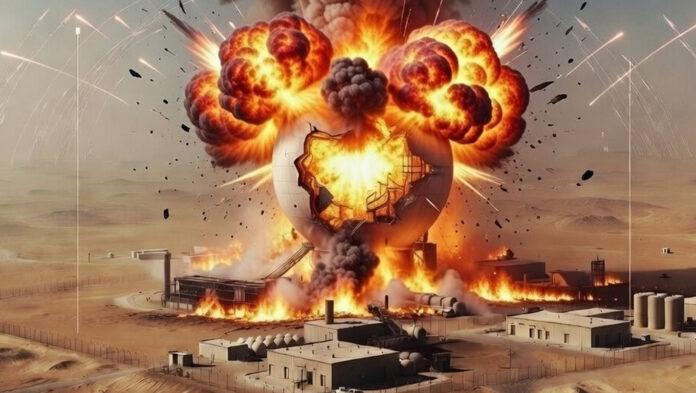
Escalating tensions between Iran and the United States in West Asia have taken a significant turn after reports emerged that an Iranian strike targeted a major US missile early warning radar system in Qatar. The radar, believed to have a detection range of about 5,000 kilometers, plays a critical role in monitoring potential missile launches across the region.
Defense analysts say the incident could temporarily affect elements of the US missile defense monitoring network in the Middle East.
Strike Targets Key US Missile Warning Infrastructure
According to reports, the attack—attributed to Iran’s Islamic Revolutionary Guard Corps (IRGC)—damaged part of the missile warning infrastructure used by US forces stationed in Qatar.
The radar system is widely considered a vital component of the United States’ regional missile defense network, often described as one of the “eyes” of the system due to its ability to detect potential threats early.
The advanced radar installation reportedly cost around $1.1 billion, underscoring its strategic importance for monitoring missile activity across West Asia.
The development comes shortly after reports that a US military operation sank an Iranian vessel in the Indian Ocean, with local media suggesting more than 80 casualties. The sequence of events has contributed to a rapid escalation in tensions between the two countries.
Satellite Images Indicate Damage to Radar Site
Satellite imagery released by commercial space analytics firm Planet Labs appears to show visible damage near the radar installation and emergency response activity around the site.
The affected system is believed to be the AN/FPS-132 (Block 5) ballistic missile early warning radar, operated by the US Space Force. It is considered one of the largest missile warning radar systems deployed by the United States in the Middle East.
Defense experts reviewing the imagery say the damage pattern suggests a targeted strike on the radar infrastructure.
Possible Use of Low-Cost Attack Drones
Military analysts believe the strike may have involved low-cost attack drones, possibly similar to the Shahed-series drones frequently used in regional conflicts.
During large-scale missile and drone attacks, such drones can sometimes penetrate layered air defense systems by overwhelming radar tracking and interception capabilities.
If confirmed, the use of inexpensive drones against high-value defense infrastructure highlights the evolving nature of modern warfare.
Strategic Importance of the 5,000-km Radar System
The radar system was developed under the Upgraded Early Warning Radar (UEWR) program by US defense contractor Raytheon.
With the ability to detect and track ballistic missiles and airborne threats up to 5,000 kilometers away, the radar provides critical early-warning capability for US forces and regional allies.
Due to its strategic location in Qatar, the radar could monitor missile activity across a vast area including:
Iran
Iraq
Syria
Türkiye
Parts of Central Asia
Portions of the Indian Ocean region
This wide surveillance coverage makes it a crucial element of the US missile detection network in the Middle East.
Experts: Strike Targeted a Key Surveillance Asset
Former US military officer and Pentagon adviser Colonel Douglas Macgregor described the incident as an attack on a critical “eye” of the American missile defense system.
Geopolitical analyst Brian Allen also warned that such an attack could carry significant strategic implications for regional security.
Both experts note that early-warning radar systems play a key role in detecting incoming missile threats and enabling rapid defensive responses.
Replacing Large Radar Systems Takes Time
Military analysts say that although the United States operates a global network of sensors, satellites, and radar systems, the loss or damage of a large fixed radar installation can create temporary monitoring gaps.
Systems like the AN/FPS-132 radar are complex and costly installations that cannot be replaced quickly.
As a result, the incident may temporarily reduce missile tracking and surveillance capacity in parts of the region.
The situation is particularly sensitive because the Middle East hosts several major US military bases and includes critical global energy shipping routes that are essential to international oil supply.