New Delhi, India — May 13, 2026
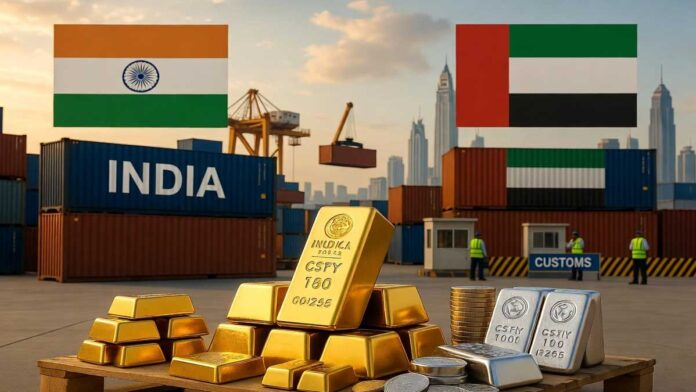
India’s decision to sharply increase import duties on gold and silver from 6 percent to 15 percent is expected to significantly reshape the country’s bullion trade dynamics, with analysts predicting a major rise in imports routed through Dubai under the India-UAE trade agreement.
According to economic think tank Global Trade Research Initiative (GTRI), the revised tariff structure could create a substantial pricing advantage for bullion entering India through the United Arab Emirates under the Comprehensive Economic Partnership Agreement (CEPA).
The policy shift is already drawing attention across global bullion markets, commodity trading circles, and import businesses due to its potential impact on pricing, sourcing patterns, and customs arbitrage opportunities.
India’s New Import Duty Structure Explained
Under the previous system, imports of gold and silver attracted a 5 percent Basic Customs Duty (BCD) along with a 1 percent Agriculture Infrastructure and Development Cess (AIDC), bringing the total customs levy to 6 percent.
After adding the 3 percent Integrated Goods and Services Tax (IGST), the effective import duty stood at approximately 9.18 percent.
However, under the revised framework announced by the Indian government:
- Basic Customs Duty has been doubled from 5% to 10%
- AIDC has been increased fivefold from 1% to 5%
As a result, the total customs duty on gold and silver imports has jumped from 6 percent to 15 percent, while the effective import burden, including IGST, has surged to approximately 18.45 percent.
The sharp increase is expected to raise the cost of direct bullion imports into India and alter sourcing strategies for traders and importers.
Why Dubai Could Become the Biggest Beneficiary
Experts believe the new tariff structure could dramatically increase bullion imports routed through Dubai due to preferential treatment available under the India-UAE CEPA agreement.
India had earlier agreed to allow gold imports from the UAE at tariffs lower than the standard Most Favored Nation (MFN) rates under a Tariff Rate Quota (TRQ) mechanism.
The quota system began in 2022 with an annual allocation of 120 metric tons and is scheduled to gradually expand to 200 metric tons by 2027, representing nearly one-fourth of India’s annual gold imports.
Under the revised customs structure, bullion imported through the UAE quota system would effectively enter India at a 14 percent duty, compared to the standard 15 percent tariff applied to other imports.
According to GTRI, this tariff differential may encourage global bullion suppliers to increasingly route shipments through Dubai, even though the UAE itself is not a major producer of gold or silver.
Silver Imports Could See Even Bigger Arbitrage Gains
The impact may be even more significant in the silver trade.
Under the CEPA agreement signed between India and the UAE, India committed to gradually reducing import duties on silver from 10 percent to zero over a ten-year period beginning in May 2022.
Currently, silver imported from the UAE attracts a concessional tariff of around 7 percent.
GTRI Founder Ajay Srivastava stated that India’s decision to raise the standard import tariff to 15 percent has now widened the duty gap to nearly 8 percentage points.
According to trade experts, this difference creates a highly attractive arbitrage opportunity for importers using Dubai as a trading hub.
Analysts also noted that this tariff advantage could continue expanding every year until 2031 as CEPA-linked silver tariffs gradually move toward zero.
Bullion Import Surge Already Raising Concerns
The policy change comes at a time when India is already witnessing a sharp increase in precious metal imports.
During the financial year 2025-26:
- India imported nearly $72 billion worth of gold
- Gold imports rose by approximately 25 percent year-on-year
- Silver imports recorded an extraordinary 150 percent annual increase
The rapid growth in bullion imports has intensified concerns over trade imbalances, currency outflows, and customs monitoring challenges.
Economists believe the revised tariff structure could unintentionally accelerate indirect imports through preferential trade routes unless customs enforcement mechanisms are strengthened.
GTRI Urges Simpler Customs Rules
Apart from concerns over rising imports, GTRI has also called on India’s Finance Ministry to simplify the language and structure of customs notifications related to the revised tariff system.
According to the think tank, the current framework forces importers, customs agents, and legal experts to examine multiple customs notifications issued over the last 26 years in order to accurately calculate applicable duties.
GTRI warned that the complexity of the current documentation increases compliance risks and creates uncertainty for businesses operating in the bullion trade sector.
Trade bodies are now expected to seek additional clarifications from customs authorities regarding implementation procedures under the revised structure.
Impact on Indian Bullion Market
The sharp increase in import duties is likely to influence several segments of the Indian economy, including:
- Jewelry pricing
- Bullion trading margins
- Retail gold demand
- Silver investment flows
- Import sourcing strategies
India remains one of the world’s largest consumers of gold, with demand driven by jewelry purchases, weddings, investment demand, and cultural traditions.
Higher import costs may initially push domestic bullion prices upward, although increased imports routed through Dubai could partly offset pricing pressures over time.
Market analysts also expect increased scrutiny of re-export channels, trade documentation, and customs valuation procedures.
India-UAE Trade Pact Gains Strategic Importance
The latest developments underscore the growing strategic importance of the India-UAE Comprehensive Economic Partnership Agreement.
The CEPA agreement has already expanded bilateral trade across multiple sectors including energy, gems and jewelry, logistics, manufacturing, and digital commerce.
With bullion now emerging as a major area of tariff advantage, Dubai could strengthen its position as a critical trading gateway for precious metals entering India.
Industry observers believe policymakers may eventually review aspects of the tariff structure if trade patterns shift significantly toward preferential import channels.
Government Faces Balancing Challenge
The Indian government now faces the challenge of balancing three major priorities:
- Protecting revenue through higher import duties
- Managing rising bullion imports and trade deficits
- Preventing unintended arbitrage opportunities under trade agreements
Experts say future policy decisions will likely focus on customs simplification, tighter monitoring of import routes, and broader economic oversight of precious metal inflows.
As global bullion markets respond to India’s revised tariff structure, the India-UAE trade corridor is expected to play an increasingly influential role in shaping regional precious metal trade.