Mumbai, India — February 2026
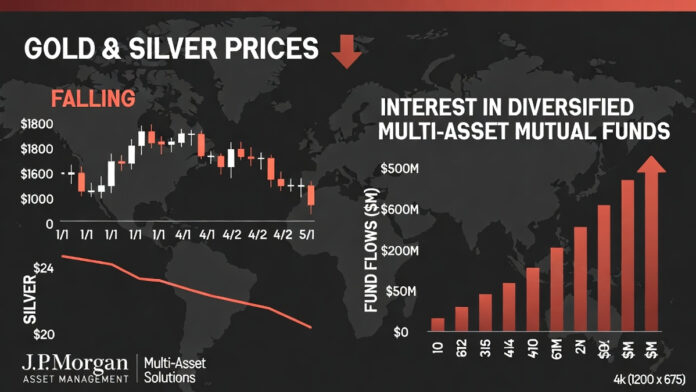
A sharp correction in gold and silver prices has triggered a significant shift in investor behavior, with growing interest in multi-asset allocation mutual funds as a safer and more balanced investment option.
After months of strong gains—especially in silver, which had attracted heavy inflows on expectations of further upside—markets were rattled by a single-day crash of nearly 25% in silver prices. The sudden fall sparked panic among retail investors, many of whom then turned to gold as a hedge. However, gold prices have also witnessed steep declines in recent trading sessions, deepening concerns across commodity-focused portfolios.
📉 Commodity Volatility Pushes Investors to Diversification
Market analysts say the recent turbulence highlights the risks of concentrated exposure to a single asset class.
As a result, investors are increasingly opting for multi-asset allocation funds, which spread investments across equities, debt instruments, and commodities such as gold and silver. This diversification helps reduce portfolio volatility and cushions investors during sharp market swings.
📊 What Are Multi-Asset Allocation Funds?
Multi-asset allocation funds are mutual funds that invest in at least three different asset classes, typically:
Equities (stocks)
Debt (bonds and fixed-income instruments)
Commodities (gold, silver, or ETFs linked to them)
Unlike traditional equity or hybrid funds, these schemes dynamically rebalance allocations based on market conditions, offering a more resilient portfolio structure.
⚖️ SEBI Rules Ensure Mandatory Diversification
Under guidelines issued by Securities and Exchange Board of India (SEBI), multi-asset allocation funds are required to invest a minimum of 10% each in at least three asset classes at all times.
Fund managers are allowed flexibility to adjust allocations depending on relative asset performance, while still maintaining regulatory diversification thresholds. This structure has made these funds particularly attractive during periods of equity volatility and low debt returns.
📈 Performance Outshines Other Categories
Multi-asset allocation funds have delivered strong risk-adjusted returns over the past few years, often outperforming both hybrid and pure equity funds during volatile phases.
Among the top performers:
Nippon India Mutual Fund – Multi Asset Allocation Fund
1-year return: 23.97%
2-year return: 20.47%
3-year return: 22.62%
Data shows that the top 10 multi-asset allocation funds delivered:
Average 1-year return: 20.26%
Average 3-year CAGR: 21.01%
In comparison, the top 10 equity mutual funds generated an average return of 16.62% over the past year, underlining the advantage of diversified exposure.
🧠 Why Investors Prefer Multi-Asset Funds Now
Financial advisors say multi-asset allocation funds are gaining traction because they:
Reduce dependence on volatile commodities
Offer smoother returns during market corrections
Provide built-in asset rebalancing
Perform well when equity markets are unstable and debt yields are muted
With both precious metals and equities experiencing heightened volatility, these funds are emerging as a preferred long-term portfolio stabilizer.
🔮 Outlook for Investors
Experts caution that while multi-asset allocation funds are not risk-free, they are better positioned to navigate uncertain markets compared to single-asset strategies.
As global commodity prices remain unpredictable and equity valuations face pressure, diversified investment approaches are expected to remain in focus throughout 2026.