New Delhi — May 16, 2026
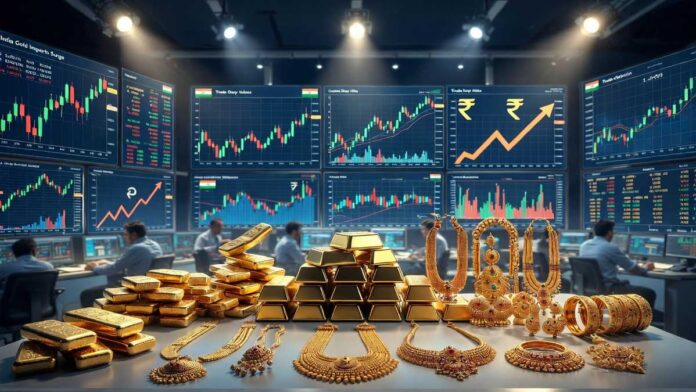
India’s gold imports surged nearly 82% in April to $5.62 billion, while silver imports jumped more than 157% to approximately $4.11 billion, despite the government’s decision to sharply raise customs duties on precious metals.
The sharp increase in imports comes amid record-high global bullion prices and growing domestic demand, according to data released by India’s Ministry of Commerce.
The Indian government increased customs duty on gold and silver imports from 6% to 15% effective May 13 in an effort to discourage excessive imports and contain the country’s widening trade deficit.
Gold Imports Reach Record Levels
Commerce Ministry figures showed that during fiscal year 2025-26, India’s total gold imports rose 24% to a record $71.98 billion.
However, import volumes declined by 4.76% to 721.03 metric tons during the same period, indicating that the overall rise was driven largely by soaring international gold prices rather than higher physical demand.
Silver imports also recorded a major jump, rising nearly 150% to around $12 billion.
In volume terms, silver imports climbed 42% to 7,334.96 metric tons, reflecting strong industrial and investment demand.
Government Expects Duty Hike to Slow Imports
Commerce Secretary Rajesh Agrawal said the higher import duty is expected to reduce precious metal imports during the current fiscal year.
He noted that while gold demand linked to consumption may decline significantly, the impact on silver imports could remain comparatively limited because of strong industrial usage.
“Consumption-driven demand will certainly see moderation,” Agrawal said while discussing the government’s policy response.
He also clarified that the tariff-rate quota mechanism under the India-UAE Comprehensive Economic Partnership Agreement (CEPA) has not had a major impact on gold imports so far.
Record Bullion Prices Drive Import Value Higher
Analysts said the sharp rise in import values was closely tied to elevated bullion prices in global and domestic markets.
Gold prices in New Delhi are currently trading near ₹156,000 per 10 grams, while silver prices have climbed to around ₹253,000 per kilogram.
Switzerland remains India’s largest gold supplier, accounting for nearly 40% of imports. The United Arab Emirates and South Africa are also major exporters of precious metals to India.
Precious metals now account for more than 5% of India’s total imports, highlighting their growing influence on the country’s external trade balance.
Trade Deficit Climbs to Three-Month High
The spike in gold and silver imports contributed to India’s trade deficit widening to a three-month high of $28.38 billion in April.
India’s current account deficit stood at $13.2 billion during the December quarter, equivalent to 1.3% of gross domestic product, primarily due to a wider merchandise trade gap caused by slowing exports.
According to data released earlier by the Reserve Bank of India, India’s current account deficit narrowed to $30.1 billion during April-December 2025.
Economists believe the latest increase in customs duties could help moderate future imports and support macroeconomic stability if bullion prices remain elevated globally.
Refining Sector Continues to See Positive Trends
Officials also noted that imports of gold dore — unrefined gold used by domestic refiners — have remained positive.
These imports originate from multiple regions including Africa, Latin America and the United States, supporting India’s refining industry and downstream jewelry manufacturing sector.
The government hopes that higher duties combined with stronger domestic refining capacity will help reduce pressure on foreign exchange reserves and improve the country’s external balance over the coming months.