New Delhi, India — March 13, 2026
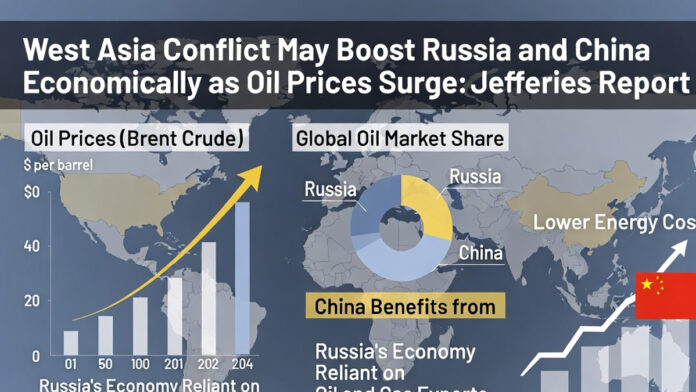
The ongoing conflict in West Asia is reshaping global energy and financial markets, with a new report suggesting that some major economies could benefit economically from the turmoil. According to a report by Jefferies, countries such as Russia and China may emerge as key economic beneficiaries of the current geopolitical situation.
The report highlights that rising crude oil prices and shifting global trade dynamics could strengthen Russia’s energy revenues while China may gain from relatively stable domestic financial markets.
Oil Price Surge May Boost Russia’s Energy Revenue
The report noted that escalating tensions in West Asia have triggered a sharp rise in global crude oil prices, which could significantly benefit Russia’s energy sector.
Higher oil prices typically translate into increased export revenues for Russia, potentially strengthening its position in the global energy market.
The report also suggested that the geopolitical situation may reduce concerns around India’s continued purchases of Russian oil, as supply from Russia becomes more critical amid rising prices and uncertainty in other energy routes.
China May Benefit From Domestic Market Stability
While energy markets are facing volatility globally, the report pointed out that China’s relatively stable domestic economic environment could provide it with a strategic advantage.
According to analysts, the Chinese government is working on a long-term strategy to strengthen its stock markets, gradually positioning them as a major avenue for wealth creation for households.
This strategy is particularly important as China’s real estate sector continues to face structural challenges. As a result, policymakers are encouraging investors to shift focus toward equity markets.
The Shanghai stock market’s gradual upward trend is being viewed by analysts as part of this broader policy approach.
Warning Over Global Energy Route Disruptions
Despite potential economic gains for certain countries, the report warned that continued disruption to global energy routes could have serious consequences for the global economy.
Particular concern surrounds the Strait of Hormuz, one of the world’s most critical energy transit corridors.
If the Strait of Hormuz were to remain blocked or severely disrupted for an extended period, it could trigger a major global energy crisis and disrupt supply chains across multiple sectors.
U.S. Decision to Release Strategic Oil Reserves
Meanwhile, the United States has announced plans to release 172 million barrels of oil from its strategic reserves starting next week.
The report suggests that this decision could reflect a lack of long-term energy strategy, noting that the reserve had not been replenished to optimal levels before the release.
Currently, the U.S. Strategic Petroleum Reserve holds about 415 million barrels of oil, roughly 58 percent of its maximum capacity of 714 million barrels. This is significantly lower than the 656 million barrels recorded in July 2020.
Potential Political Risks for the U.S. President
The report also noted that military decisions related to Iran could pose political risks for Donald Trump.
Some analysts have compared the situation to a potential “Suez moment,” a term used to describe a historic turning point when a major global power’s influence appears to weaken.
The phrase originates from the Suez Crisis, which marked a significant shift in global power dynamics.
Global Markets Watching Closely
As geopolitical tensions continue to evolve, global markets are closely monitoring developments in energy supply routes, oil prices, and major economic policy responses.
Analysts suggest that the trajectory of oil prices and stability of energy shipping routes will play a critical role in determining the broader economic impact of the West Asia conflict in the coming months.