
New York, United States — March 6, 2026
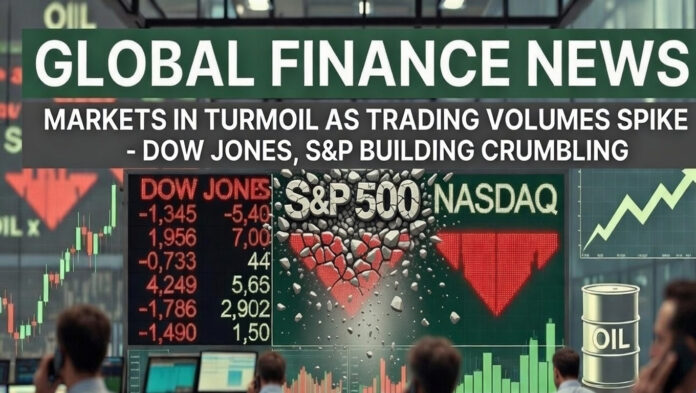
US stock markets experienced a sharp decline on Thursday as escalating geopolitical tensions in West Asia and a surge in global oil prices unsettled investors. Major indices including the Dow Jones Industrial Average, S&P 500, and Nasdaq Composite closed lower as energy market volatility raised concerns about inflation and economic stability.
The market reaction reflects growing investor caution as the ongoing conflict threatens energy supply chains and increases uncertainty across global financial markets.
Dow Jones Drops Over 1,000 Points
The Dow Jones Industrial Average fell 1,046 points, or about 2.1%, marking one of the steepest declines in recent sessions.
The S&P 500 index dropped 1.3%, while the Nasdaq Composite slipped 1.1%, reflecting broad weakness across multiple sectors.
Market analysts attribute the sell-off largely to rising oil prices linked to escalating tensions in West Asia.
Oil Prices Surge Amid Escalating Conflict
The latest market turmoil comes as Brent crude prices rose 4.7% to approximately ₹7,821 per barrel, while US crude oil jumped 8.1% to around ₹7,403 per barrel.
Notably, US crude oil crossed the ₹7,342 mark for the first time since August 2024, highlighting the magnitude of the price surge.
The spike in oil prices follows a new wave of attacks attributed to Iran targeting Israel, US military installations, and regional countries, raising fears of prolonged disruptions to global energy production and transportation.
Rising Fuel Costs Begin to Impact Consumers
Higher energy prices are already affecting consumers in the United States.
The average price of gasoline has risen to approximately ₹298 per gallon, compared with ₹273 per gallon last week. Rising fuel costs reduce household spending power, which can negatively affect retail and consumer service sectors.
Retail and Airline Stocks Hit Hard
Several sectors experienced notable declines as investors reacted to the economic implications of higher fuel costs.
In the retail sector, American Eagle Outfitters shares fell 14.8%, despite the company reporting stronger-than-expected revenue and profit.
Airline stocks also suffered heavy losses due to higher fuel costs and travel disruptions linked to the conflict:
American Airlines: down 6.6%
United Airlines: down 6.8%
Delta Air Lines: down 5.3%
Analysts say rising fuel costs directly increase operational expenses for airlines while reducing consumer travel demand.
Technology Sector Offers Some Positive Signals
Despite broader market weakness, the technology sector showed limited resilience.
Semiconductor company Broadcom reported strong earnings, highlighting a 74% increase in AI chip sales. The positive results pushed the company’s shares up 3.6%, offering a rare bright spot in an otherwise volatile trading session.
Bond Market Reacts as Treasury Yields Rise
The surge in oil prices also influenced the bond market.
The 10-year US Treasury yield climbed to 4.13%, reflecting expectations that inflation could remain elevated. Higher yields suggest the Federal Reserve may keep interest rates elevated for a longer period, which could slow economic growth by increasing borrowing costs.
Although the Federal Reserve previously signaled potential rate cuts this year, rising geopolitical risks and energy prices could delay that timeline.
Mixed Signals From the US Economy
Economic indicators released this week offered a mixed outlook. Initial jobless claims declined slightly, indicating continued resilience in the US labor market.
However, investors remain cautious as geopolitical developments and energy price fluctuations continue to shape market sentiment.
Global Markets Show Diverging Trends
Global markets reacted differently to the geopolitical developments:
Asia: South Korea’s KOSPI index rose 9.6%, recovering part of its earlier record decline.
Europe: Major European markets moved lower amid rising oil prices.
France’s CAC 40: down 1.5%
Germany’s DAX: down 1.6%
Expert Advice for Investors
Market strategists say geopolitical shocks often trigger short-term volatility in financial markets.
Scott Wren, senior global market strategist at Wells Fargo Investment Institute, noted that while the risk of escalation remains, market reactions to geopolitical conflicts are often temporary.
He advised investors to remain patient and avoid panic-driven decisions. However, Wren warned that if oil prices rise toward $100 per barrel and remain elevated for an extended period, the global economy could face significant pressure.
In such a scenario, both investors and consumers could experience rising financial strain.











Comments are closed.