
Mumbai, India — March 6, 2026
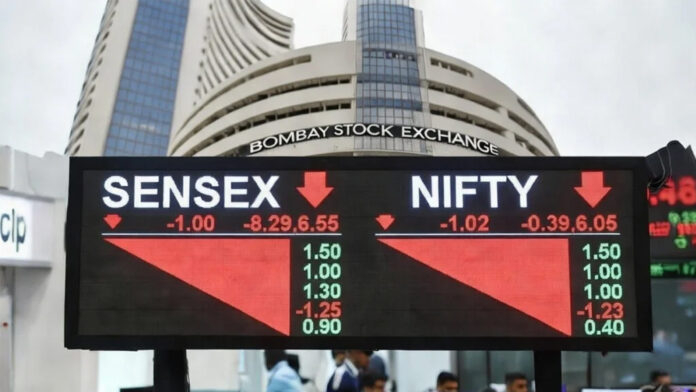
India’s stock market opened in negative territory on Friday, the final trading day of the week, with benchmark indices Sensex and Nifty slipping in early trade. The decline comes a day after markets recorded strong gains, reflecting cautious investor sentiment amid global economic signals and movements in crude oil prices.
Sensex Drops Over 350 Points in Early Trade
In early trading on Friday, the BSE Sensex, which tracks 30 major companies, fell 356.91 points or 0.45% to 79,658.99.
At the same time, the NSE Nifty 50 index declined 148.15 points or 0.60% to 24,617.75, slipping below the key 24,700 level shortly after the opening bell.
The market opened in the red despite strong gains in the previous session. On Thursday, the Sensex surged 899.71 points to close at 80,015.90, while the Nifty gained 285.40 points to settle at 24,765.90.
Rupee Remains Stable Against the US Dollar
The Indian rupee remained largely stable, gaining 2 paise to trade at 91.62 against the US dollar in early forex market activity.
The slight strengthening of the rupee followed reports that the United States granted Indian refineries a 30-day exemption to continue purchasing Russian oil. Analysts say the move could ease pressure on global energy flows at a time when geopolitical tensions remain elevated in West Asia.
Expert View: Oil Prices Key for Market Direction
According to international investment consultant Ratnam Chandra, crude oil prices have risen by roughly 16% since the start of the ongoing geopolitical conflict, but the increase is still relatively moderate compared with previous global crises.
Chandra noted that expectations of ample global oil supply are helping prevent sharper price spikes.
He added that if tensions in West Asia ease, crude prices could fall significantly, which may support a rebound in global equity markets.
Brent Crude Levels Crucial for Investors
Chandra said investors should closely track Brent crude oil prices, as they could influence market sentiment.
If Brent crude remains near $85 per barrel, the impact on financial markets is likely to stay limited.
However, if prices rise above $90 and approach $100 per barrel, global markets could face increased volatility.
For now, analysts say the direction of oil prices and geopolitical developments will remain key factors influencing investor sentiment in the coming trading sessions.