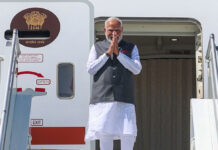
Prime Minister Narendra Modi on Sunday declared that Left-Wing Extremism (LWE) — commonly referred to as “Red Terror” — has been reduced from 125 affected districts to just three, marking what he called “the most decisive victory against internal insurgency in independent India.”
Speaking at the National Internal Security Conference in New Delhi, the Prime Minister attributed the achievement to “coordinated development, intelligence-based policing, and public participation.” He emphasized that India’s internal security ecosystem has “moved from fear to freedom” over the past decade.
A Decades-Long Insurgency Nears Its End
Naxalism, rooted in the 1967 peasant uprising in Naxalbari, West Bengal, had spread through the “Red Corridor” across 10 Indian states, particularly Chhattisgarh, Jharkhand, Odisha, Bihar, and Maharashtra.
According to official data released by the Ministry of Home Affairs (MHA), active extremist presence has now been confined mainly to parts of Bijapur (Chhattisgarh), Gadchiroli (Maharashtra), and Malkangiri (Odisha) — areas once considered insurgent strongholds.
Union Home Minister Amit Shah, addressing the same event, said that 2025 marks “the first year when over 95% of India’s population lives in areas completely free of LWE influence.” He credited “consistent leadership, modern policing, and socio-economic inclusion” for the turnaround.
Operation Samadhan-Prahar: The Turning Point
The decline of Left-Wing Extremism gained pace under the Operation Samadhan-Prahar framework launched in 2017, integrating security operations, intelligence, infrastructure, and rehabilitation under a single national plan.
An MHA report tabled during the conference highlighted that from 2014 to 2025, violent incidents linked to Maoist activity fell by 83%, and deaths of security personnel decreased by 90%.
“The joint command structure between the CRPF, state police forces, and local intelligence units has been pivotal,” said Kuldiep Singh, former Director General of CRPF. “Today, more than 250 remote villages that were once under Maoist shadow are now connected by roads, schools, and mobile networks.”
Development Over Deterrence
Experts say that the success of the anti-Naxal campaign owes as much to development initiatives as to security force coordination. Programs like the Aspirational Districts Scheme, Rural Roads Mission, and Digital India have opened new avenues for livelihood and connectivity in regions previously isolated from governance.
According to data from the NITI Aayog, average literacy in former LWE zones has improved by 24%, and poverty rates have halved since 2015.
In his address, PM Modi emphasized that “bullets could not solve what development could achieve,” adding, “When a mother in Sukma receives medical care or a child in Dantewada attends school without fear, that is the true victory of democracy.”
Humanitarian Approach and Rehabilitation
The MHA’s rehabilitation and surrender policy has reportedly helped over 9,000 former Maoist cadres reintegrate into civil society since 2018. Vocational training, employment schemes, and housing assistance were cited as factors discouraging youth from joining extremist outfits.
“The state’s approach is now people-centric rather than force-centric,” said Dr. Ajay Sahni, Executive Director of the Institute for Conflict Management. “The combination of intelligence precision and developmental empathy has shifted the ground reality permanently.”
Challenges That Remain
Despite the successes, officials warn against complacency. Intelligence agencies report that splinter groups of the CPI (Maoist) continue to maintain underground networks across forested belts near state borders.
“The Maoist ideology may have weakened militarily, but it persists ideologically in pockets of discontent,” cautioned a senior MHA official on condition of anonymity. “Continued vigilance and community engagement are essential to prevent resurgence.”
Civil rights groups have also urged the government to ensure that counter-insurgency efforts do not compromise human rights. The People’s Union for Civil Liberties (PUCL) emphasized the need for transparent investigations into alleged custodial abuses and misuse of special powers.
International Acknowledgment
India’s internal security turnaround has drawn attention from global think tanks. A recent RAND Corporation study termed India’s LWE strategy “a model for hybrid conflict management combining military containment with socio-political assimilation.”
Analysts at the Observer Research Foundation (ORF) noted that India’s success comes at a time when several democracies are struggling to address internal insurgencies through purely militarized responses.
The Road Ahead
Home Minister Amit Shah announced that the government would soon launch “Operation Vikas Jyoti”, focusing on post-insurgency development, youth employment, and eco-tourism in liberated zones.
He added, “Our aim is not just to eliminate Naxalism, but to replace it with opportunity. Every village that once heard the echo of gunfire should now hear the sound of progress.”