New Delhi, January 20, 2026
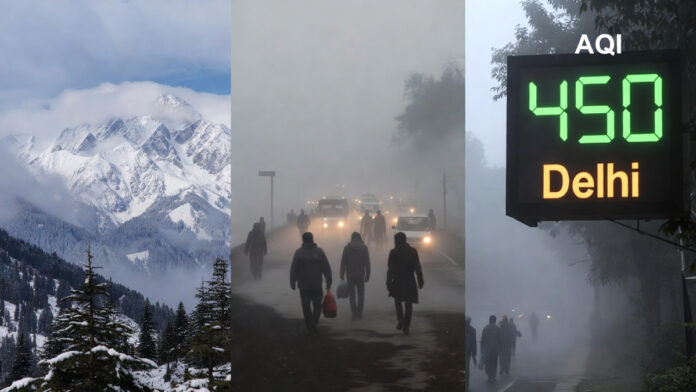
Rain and snowfall over high-altitude regions of Jammu & Kashmir, Himachal Pradesh and Uttarakhand have brought brief relief from the intense cold wave gripping North India. Minimum temperatures have risen slightly across the plains, offering temporary respite from severe cold conditions and dense fog. However, the India Meteorological Department (IMD) has cautioned that this relief may be short-lived as back-to-back western disturbances are expected to impact the western Himalayan region and adjoining plains over the next seven days.
Temperatures Rise Slightly Across Northern States
According to IMD data recorded at 8:30 a.m. on Monday, Srinagar’s minimum temperature rose to –1.2°C, up from –4.7°C the previous night. In Punjab, Amritsar recorded a minimum of 2.9°C, still one degree below normal but higher than previous days. Haryana’s Bhiwani was the coldest at 3°C, while Gurugram recorded 5.5°C. Delhi saw a minimum temperature of 7.7°C, indicating marginal improvement.
Rajasthan also experienced relief from severe cold conditions, with most cities recording minimum temperatures above 10°C. Alwar remained the coldest at 7.2°C, while Sirohi, Sri Ganganagar, Bikaner and Nagaur registered sub-10°C temperatures.
Dense Fog Reduces Slightly but Remains Severe in Many Areas
The IMD reported a reduction in dense fog intensity, though several regions continued to experience very low visibility on Monday morning. Extremely dense fog (visibility below 50 meters) was recorded in parts of Punjab, eastern Uttar Pradesh, Haryana and western Uttar Pradesh. Some areas in eastern Rajasthan, Bihar and Meghalaya witnessed dense fog with visibility ranging between 50–199 meters.
In certain pockets — including Amritsar (Punjab), Ayodhya, Fursatganj and Lucknow (Uttar Pradesh) — visibility dropped to zero meters, severely affecting early morning movement and transport.
Rain and Snow Forecast Across Western Himalayas
The IMD warned of a fresh spell of light to moderate rain and snowfall in Jammu & Kashmir, Ladakh, Gilgit-Baltistan, Muzaffarabad and Himachal Pradesh from January 20 to 22. A more intense system is expected from January 22 to 24, with heavy snowfall likely in high-altitude areas of Kashmir, Ladakh and Himachal Pradesh on January 23. Authorities caution that heavy snowfall may disrupt normal life, road connectivity and mountain travel.
Fog and Cold Wave Alerts Issued
A dense fog alert has been issued for several regions of Uttar Pradesh for January 20–21, while Delhi and adjoining areas may continue to experience fog till January 20. Parts of Himachal Pradesh may witness cold wave conditions between January 20 and 22.
Severe Pollution Continues in Delhi-NCR
Despite GRAP Stage IV restrictions in effect across Delhi-NCR to curb emissions, air quality remains hazardous. As of 4 p.m., Delhi’s Air Quality Index (AQI) was 410, placing it in the severe category. Noida recorded an AQI of 412, Ghaziabad 425, while Greater Noida and Gurugram saw AQI levels in the ‘very severe’ range.
Health Risks Rising Due to Fog and Pollution
Health experts warn that dense fog combined with toxic air poses a significant risk. Pollutants and microscopic fog particles can enter the lungs, exacerbating symptoms like coughing, breathlessness, chest congestion and wheezing. Patients suffering from asthma or bronchitis have been advised to exercise extreme caution. Eye irritation, redness and swelling may also increase due to polluted air, while extremities like fingers, toes, nose and ears remain vulnerable to cold-related complications.