NEW DELHI, India — May 24, 2026
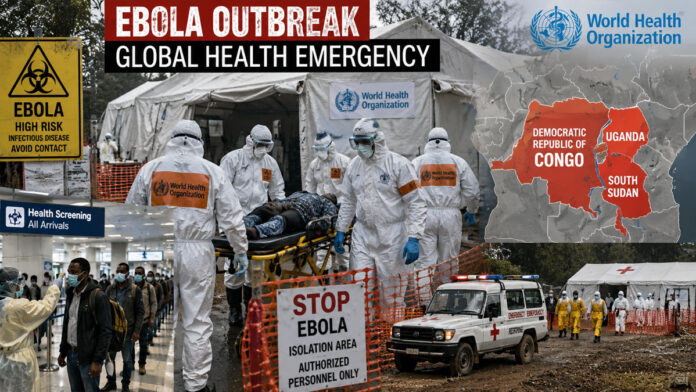
India Ebola Alert has been issued after the World Health Organization (WHO) declared the rapidly spreading Ebola outbreak in parts of Central Africa a global public health emergency under the International Health Regulations (IHR) 2005 framework.
The emergency declaration follows a sharp rise in Ebola infections reported in the Democratic Republic of Congo and neighboring Uganda, raising international concerns over the spread of the deadly virus. According to officials, the decision was formally announced on May 17 amid increasing cross-border health risks and growing fears of wider regional transmission.
In response to the evolving situation, the Government of India has advised citizens to avoid all non-essential travel to the Democratic Republic of Congo, Uganda, and South Sudan. Indian authorities said the advisory was issued as a precautionary measure to minimize the risk of exposure and prevent possible imported cases.
WHO Raises International Alarm Over Ebola Spread
The World Health Organization classified the outbreak as a major international public health concern after health agencies recorded a rapid increase in suspected and confirmed Ebola cases across affected regions.
Ebola is considered one of the world’s most dangerous viral diseases due to its high fatality rate and ability to spread through direct contact with infected bodily fluids. Symptoms often include fever, severe weakness, vomiting, bleeding complications, and organ failure in severe cases.
Global health experts fear that limited healthcare infrastructure and increased regional movement could make containment more difficult if immediate preventive measures are not strengthened.
The WHO emergency declaration enables faster international coordination, emergency funding access, medical support deployment, and heightened monitoring at airports and border checkpoints worldwide.
India Strengthens Precautionary Measures
Indian health authorities are closely monitoring the developments in Africa and reviewing preparedness measures at major international airports and ports of entry.
Officials have emphasized that no Ebola cases have been reported in India so far. However, enhanced surveillance and health screening protocols may be intensified for travelers arriving from high-risk regions.
The Ministry of Health and Family Welfare is also expected to coordinate with airport authorities and state health departments to ensure rapid response readiness if needed.
Public health experts in India have urged travelers to remain cautious and follow all official advisories related to international travel and health safety.
Ebola Remains a High-Risk Global Health Threat
Ebola outbreaks have historically posed serious global health challenges because of the virus’s severe mortality rate and the difficulty of controlling transmission in densely populated or medically under-resourced regions.
Previous Ebola outbreaks in Africa prompted large-scale international emergency responses and travel restrictions, with health agencies stressing the importance of early detection and rapid isolation measures.
Medical authorities say public awareness, timely reporting of symptoms, and strict infection-control practices remain essential in limiting the spread of the disease.
As the outbreak continues to evolve, global health agencies and governments are expected to increase coordination efforts to contain the virus and prevent wider international transmission.