Mumbai, February 9, 2026
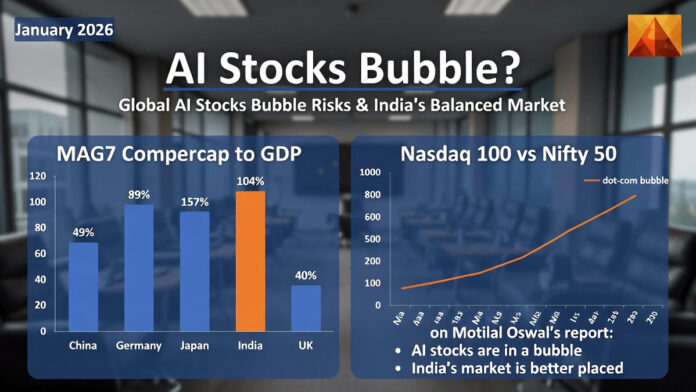
A new report from Motilal Oswal Private Wealth flags growing concerns about a potential bubble in artificial intelligence-related stocks in global equity markets. However, it states that the Indian market stands in a relatively secure position due to limited direct exposure to pure-play AI companies and a more diversified structure.
The report points out that global markets, especially in the United States, have seen sharp boom-and-bust cycles driven by technology-heavy indices. In contrast, Indian equities have historically demonstrated greater resilience during similar periods.
Magnificent Seven Dominance Highlights Global Risks
One key comparison in the report focuses on the “Magnificent Seven” (MAG7) stocks — Alphabet (Google), Amazon, Apple, Meta Platforms, Microsoft, Nvidia, and Tesla. Their combined market capitalization stands at $19.4 trillion, equivalent to China’s GDP of $19.4 trillion and significantly larger than the GDPs of Germany ($5.3 trillion), Japan ($4.3 trillion), India ($4 trillion), and the UK ($3.7 trillion). This underscores the scale of valuation risks in global technology-dominated markets.
Historical Lessons from the Dot-Com Bubble
The report draws parallels with the dot-com bubble (1995–2000), a period of excessive speculative investment in internet-based companies that peaked on March 10, 2000, followed by a sharp decline through 2002.
Performance comparison between Nasdaq 100 and Nifty 50:
| Period | Nasdaq 100 Return | Nifty 50 Return |
|---|---|---|
| 1996–2000 (Bubble Growth) | +643% | +80% |
| 2000–2003 (Burst) | -75% | -39% |
| 2003–2007 (Recovery) | +88% | +557% |
These historical trends show India experienced less extreme volatility during the dot-com era.
Recent Performance and Valuations
From January 2016 to January 2026, the Nasdaq 100 delivered a 494% return, compared to over 246% for the Nifty 50. However, price-to-earnings (PE) re-rating told a different story: 88% for Nasdaq 100 versus just 28% for Nifty 50, indicating lower valuation inflation in Indian equities.
The report concludes that India’s limited participation in pure AI companies and lower dependence on a few high-valued tech stocks provide a layer of protection against any potential AI-driven bubble burst. This balanced structure makes Indian markets less vulnerable to sharp corrections fueled by excessive optimism around AI.