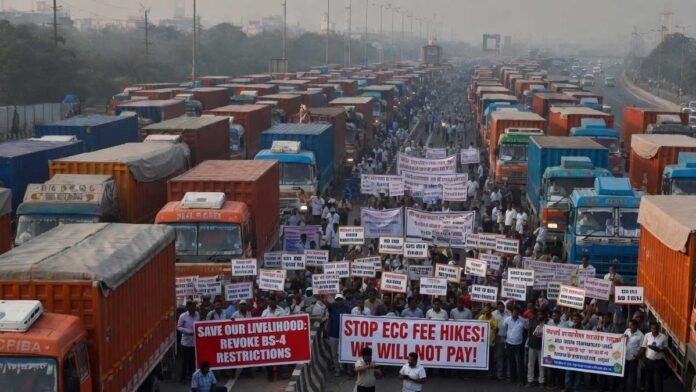
NEW DELHI, India — May 20, 2026
More than 68 transport associations and trade unions across Delhi-NCR have announced a three-day transport shutdown from May 21 to May 23 in protest against new environmental charges and proposed restrictions on commercial vehicles.
The strike, led by the All India Motor Transport Congress, is aimed at opposing policies introduced by the Commission for Air Quality Management and the Delhi government. Transport operators claim the measures will place severe financial pressure on the trucking and logistics sector across northern India.
According to industry representatives, the latest increase in the Environmental Compensation Charge (ECC) has triggered widespread anger among transport operators. The revised fee structure reportedly raises charges for light commercial vehicles entering Delhi from around Rs 1,400 to Rs 2,000, while heavy trucks could now pay up to Rs 4,000 instead of the earlier Rs 2,600.
Transport unions argue that the increase amounts to a 40% to 55% rise in operational costs, adding further strain to a sector already dealing with rising fuel prices, maintenance expenses, and slowing freight demand.
Dr. Harish Sabharwal, a senior representative of the transport body, said the new ECC rules are being applied uniformly without distinguishing between transit vehicles and trucks delivering essential goods within Delhi.
Industry groups stated that the Supreme Court’s earlier intention was primarily to restrict non-destination transit vehicles using Delhi as a corridor route. However, they claim the current implementation also affects trucks carrying essential commodities and even empty commercial vehicles entering the capital for loading purposes, categories that were previously exempt from such charges.
The transport sector has also strongly opposed the proposed restriction on BS-4 and older commercial vehicles entering Delhi beginning November 1, 2026. Union leaders described the move as “unscientific” and economically damaging, arguing that BS-4 vehicles continue to comply with modern emission standards and are permitted to operate even during stricter pollution control phases under the Graded Response Action Plan (GRAP).
Transport associations estimate that more than 1.7 million truck operators and their families across Delhi-NCR could face livelihood disruptions if the proposed restrictions are enforced.
The organizations further questioned the effectiveness of the ECC system itself. According to union estimates, authorities have collected thousands of crores of rupees in environmental compensation charges since 2015, yet air quality improvements in the capital region remain limited.
Industry representatives claimed that by December 2025, approximately Rs 1,753.2 crore had been collected through ECC-related charges, with nearly 55% of the funds reportedly remaining unutilized.
The protesting unions are demanding an immediate rollback of the revised ECC rates, exemption for non-transit and essential goods vehicles, and withdrawal of the proposed BS-4 commercial vehicle entry ban.
With the three-day strike expected to impact freight movement, supply chains, and wholesale markets across the National Capital Region, businesses and logistics operators are closely monitoring the situation ahead of the planned shutdown.