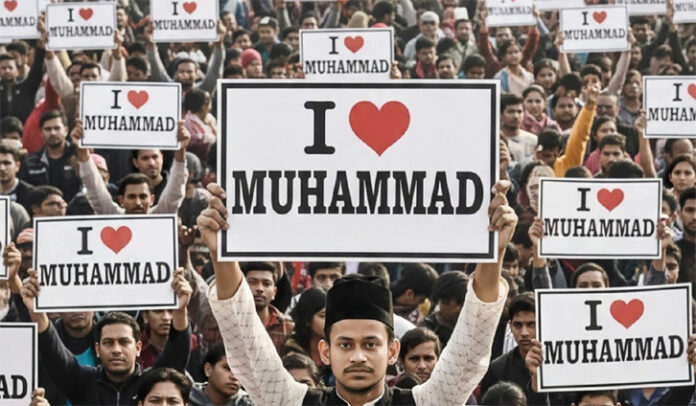
In a move that has sparked widespread debate over religious freedom and civil liberties, hundreds of Muslims in India have been charged for chanting “I love Muhammad” during religious gatherings. The incident, reported in BJP-ruled states, has drawn criticism from human rights activists, opposition leaders, and civil society organizations, raising questions about the limits of freedom of expression in India.
Background of the controversy
The charges stem from local authorities interpreting the chant as a potential provocation, though organizers insist it is purely a religious expression. Several participants have been called for questioning, and some have faced legal notices or arrests under sections of the Indian Penal Code related to public order.
“This is a blatant violation of constitutional rights,” said Shahid Ali, a civil rights lawyer. “Freedom of religion and expression is enshrined in the Indian Constitution, yet citizens are being penalized for an innocuous chant.”
Political and social implications
The controversy has quickly become a political flashpoint, with opposition parties criticizing the ruling BJP governments for allegedly targeting religious minorities. Congress and regional parties have condemned the actions, calling them a misuse of authority and a threat to secularism.
Analysts note that the issue intertwines religious identity and politics, making it highly sensitive in a state that has experienced prior communal tensions. Social media has been flooded with discussions and debates, often amplifying the polarization.
Reactions from human rights groups
Several national and international human rights organizations have expressed concern. The People’s Union for Civil Liberties (PUCL) described the charges as “unjust and chilling to freedom of expression,” urging immediate withdrawal of all legal actions against participants.
“Criminalizing peaceful religious expression erodes trust in democratic institutions,” stated Meena Sharma, spokesperson for PUCL. “The government must uphold the rights guaranteed to all citizens, irrespective of religion.”
Government response
Officials have defended the actions, claiming they were necessary to maintain law and order and prevent any potential escalation of communal tensions. However, critics argue that such a rationale is disproportionate and discriminatory, particularly when no evidence of violence exists.
“Authorities are overreaching in the name of public order,” said political commentator Raghav Menon. “This is a legal and ethical gray area with serious implications for minority rights in India.”
Public debate and media coverage
The incident has sparked a vibrant debate in Indian media, with editorial columns, television debates, and social media discussions dissecting the limits of religious freedom. Many journalists have highlighted the broader context of minority rights under current political administrations, drawing parallels with earlier controversies in other states.
Public opinion appears divided, with some citizens supporting the government’s law-and-order justification, while a significant number advocate for the protection of constitutional freedoms.
Legal perspectives
Legal experts emphasize that the Indian Constitution guarantees freedom of religion and speech, but also allows reasonable restrictions in the interest of public order, morality, and health. The current controversy raises a key question: where should the line be drawn?
“The judiciary may ultimately have to weigh in,” noted Dr. Anjali Rao, constitutional law scholar. “Cases like this test the resilience of India’s secular framework.”
Potential outcomes
The ongoing legal proceedings and public debate could influence future legislation and government policy concerning religious expression. Civil society groups are mobilizing to monitor developments, and political parties may leverage the controversy for electoral messaging ahead of upcoming state and national elections.
Conclusion
The case of Muslims being charged for chanting “I love Muhammad” highlights the complex intersection of religion, politics, and human rights in India. While authorities cite law-and-order concerns, critics argue that the actions threaten constitutional freedoms and fuel social polarization. As the debate unfolds, the world is watching India’s commitment to religious liberty, equality, and democratic values.