New Delhi | January 18, 2026
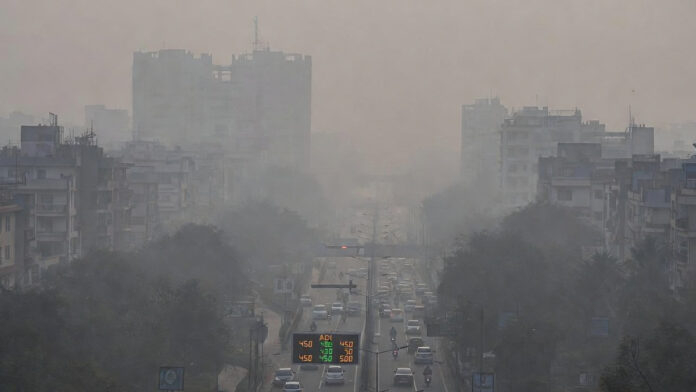
Delhi slipped into a public health emergency on Saturday as the city’s air quality deteriorated to the ‘severe’ category after four consecutive days of “very poor” pollution levels. With pollution rising sharply across the Delhi–NCR region, the Commission for Air Quality Management (CAQM) imposed GRAP Stage 4, the highest level of anti-pollution measures, with immediate effect.
By Sunday morning, Delhi’s overall Air Quality Index (AQI) reached 437, placing the capital firmly in the “severe” zone.
AQI Nears 500 in Several Localities
According to the Central Pollution Control Board (CPCB), pollution peaked in several neighborhoods across the city:
Alipur – 381
Anand Vihar – 491
Ashok Vihar – 468
Aya Nagar – 362
Bawana – 473
Burari – 465
Chandni Chowk – 465
DTU – 448
Dwarka Sec-8 – 467
IGI Airport T3 – 373
ITO – 450
Lodhi Road – 414
Mundka – 485
Najafgarh – 407
Narela – 417
Punjabi Bagh – 476
RK Puram – 468
Rohini – 484
Sonia Vihar – 475
Wazirpur – 481
Pollution levels continued to spike through Saturday evening. Delhi’s AQI, which was 400 at 4 PM, climbed to 428 by 8 PM, before rising further overnight.
GRAP Stage 4 Restrictions Enforced
With forecasts from the IMD and IITM indicating further deterioration, the CAQM’s sub-committee held an emergency meeting and approved the implementation of Stage 4 of the Graded Response Action Plan (GRAP).
Key restrictions include:
Ban on entry of BS-IV diesel trucks into Delhi
Continuation of the ban on BS-III and older diesel commercial vehicles registered outside Delhi (effective since Nov 1, 2025)
Exception for essential services, including:
Trucks carrying essential goods
Emergency service vehicles
CNG, LNG, electric, and BS-VI diesel trucks
All enforcement agencies have been directed to strictly implement GRAP Stage 1 to Stage 4 measures, while citizens have been urged to follow pollution-reduction guidelines.
What AQI Levels Mean
The Air Quality Index categorizes pollution levels as follows:
0–50: Good
51–100: Satisfactory
101–200: Moderate
201–300: Poor
301–400: Very Poor
401–500: Severe (hazardous to health)
Pollution in the 401–500 range is considered extremely harmful and can cause severe health impacts, especially for individuals with respiratory or cardiac conditions.