NEW DELHI, India — June 1, 2026
Rahul Gandhi Targets CBSE Re-Evaluation Fee Structure
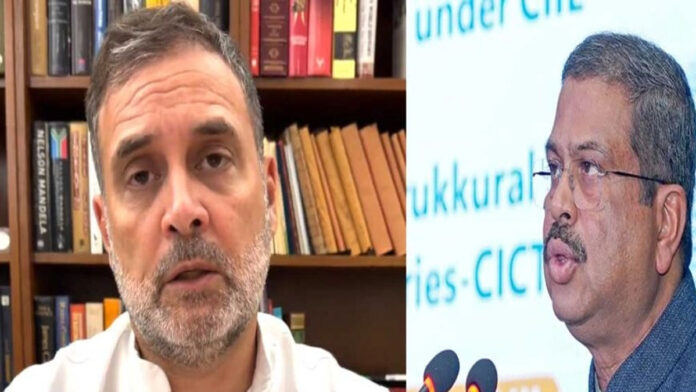
CBSE Re-Evaluation Fees have come under political scrutiny after Leader of Opposition in the Lok Sabha, Rahul Gandhi, criticized the Central Board of Secondary Education’s post-result fee structure, alleging that students are being forced to pay to correct mistakes that may originate within the board’s evaluation process.
The Congress leader questioned the charges imposed for accessing scanned answer sheets, re-totaling marks, and seeking re-evaluation of examination papers, arguing that students should not bear the financial burden of correcting potential assessment errors.
Rahul Gandhi Raises Concerns Over Post-Result Charges
In a post on social media platform X, Rahul Gandhi criticized the current fee structure followed by the Central Board of Secondary Education.
He pointed out that students are charged for several post-result services, including:
- ₹100 per subject for a digital scanned copy of the answer sheet
- ₹100 per paper for re-totaling of marks
- ₹25 per question for re-evaluation
According to Gandhi, students seeking a detailed review of their answer sheets may end up spending a significant amount simply to verify whether their marks were calculated correctly.
Congress Leader Questions Financial Burden on Students
The Congress MP argued that if mistakes occur during evaluation or scanning, students should not be required to pay additional fees to have those errors corrected.
He claimed that in some cases, students could spend up to ₹2,000 while pursuing a complete review of their examination papers.
Gandhi further questioned how much revenue is being generated through such applications, citing reports that a large number of students submit requests for answer sheet reviews and re-evaluation every year.
Allegations Against the Evaluation Process
Rahul Gandhi also raised concerns about the evaluation and digitization process.
He alleged that the use of mobile-based scanning systems may increase the likelihood of errors and argued that students should not be charged to rectify mistakes that may arise during the assessment process.
According to Gandhi, education should function as a public service rather than a revenue-generating mechanism.
He stated that when educational systems become excessively commercialized, students often bear the consequences in terms of additional costs, stress, and uncertainty regarding their academic performance.
CBSE Responds to Concerns Over Evaluation Technology
The criticism comes amid ongoing discussions surrounding the Central Board of Secondary Education’s On-Screen Marking (OSM) evaluation system.
In a statement issued recently, the board said it has been closely monitoring vulnerabilities identified within the OnMark evaluation portal and has taken steps to strengthen the platform’s security infrastructure.
CBSE stated that cybersecurity experts from government agencies and premier technical institutions have been working to address potential weaknesses in the system.
Board Says Security Measures Have Been Strengthened
According to CBSE, teams of cybersecurity specialists have spent the past several days reviewing the platform and implementing safeguards designed to improve system security.
The board stated that identified vulnerabilities have been addressed and efforts are continuing to ensure there are no remaining weaknesses that could be exploited.
CBSE also acknowledged the contribution of ethical hackers and technology professionals who reported potential security concerns.
The board said it has directly engaged with some individuals who flagged issues and has taken their recommendations into consideration while improving the platform.
Debate Over Transparency and Accessibility Continues
The latest remarks by Rahul Gandhi have renewed debate over examination transparency, accessibility, and the costs associated with post-result verification processes.
Education experts have long argued that re-evaluation and answer sheet review mechanisms play an important role in maintaining confidence in examination systems. At the same time, discussions continue over whether students should bear the full cost of these services, particularly in cases where genuine discrepancies are identified.
As the issue gains public attention, stakeholders are expected to continue discussing ways to balance transparency, accountability, affordability, and administrative efficiency within India’s school examination framework.