Mumbai, India – May 19, 2026
India’s domestic equity markets traded in positive territory on Tuesday, extending gains for the second consecutive session as benchmark indices Sensex and Nifty opened higher amid strong buying in IT, banking, and blue-chip stocks.
The upbeat momentum in the market came despite continued pressure on the Indian rupee and global uncertainty linked to rising crude oil prices and geopolitical tensions.
Sensex Climbs More Than 300 Points
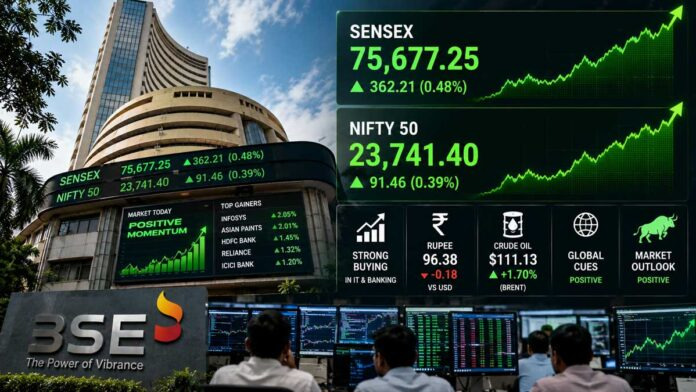
In early trade, the BSE Sensex surged 362.21 points, or 0.48 percent, to reach 75,677.25, while the NSE Nifty 50 gained 91.46 points, or 0.39 percent, to trade at 23,741.40.
The Nifty also crossed the key psychological level of 23,750 during intraday trading, reflecting improved investor sentiment across sectors.
Market analysts said buying interest remained strong in information technology, financial services, and select consumer stocks.
Infosys and Asian Paints Lead Gains
Among major gainers in early trade, shares of Infosys and Asian Paints climbed nearly 2 percent each, contributing significantly to the benchmark rally.
Traders noted that optimism around technology stocks and renewed foreign investor participation supported the market’s upward movement.
Banking and auto shares also traded with positive momentum during the opening session.
Rupee Weakens Against US Dollar
Despite gains in equities, the Indian rupee remained under pressure against the US dollar.
In early trade, the rupee weakened by 18 paise to trade at 96.38 against the dollar, extending concerns over currency volatility amid rising global crude oil prices and foreign fund outflows.
On Monday, the rupee had closed near a record low level of 96.33 against the US dollar.
Currency market experts said higher oil prices and ongoing geopolitical tensions in the Middle East continue to impact emerging market currencies, including the rupee.
Markets Ended Higher in Previous Session
The positive opening followed a resilient performance in Monday’s trading session, when benchmark indices recovered from early losses to close marginally higher.
The Sensex had ended Monday’s session up 77.05 points at 75,315.04, while the Nifty closed 6.45 points higher at 23,649.95.
Among individual stocks in the previous session:
- Bharti Airtel shares rose nearly 2 percent
- Tata Steel declined around 3 percent
The mixed movement reflected cautious investor sentiment amid global economic uncertainty and fluctuating commodity prices.
Global Factors Continue to Influence Indian Markets
Analysts believe Indian markets are currently being influenced by multiple international factors, including:
- Rising crude oil prices
- US bond yield movements
- Global inflation concerns
- Middle East geopolitical tensions
- Foreign institutional investor activity
The recent spike in crude oil prices has increased concerns over inflation and India’s import bill, as the country remains heavily dependent on imported energy supplies.
However, domestic investors continue to show confidence in India’s economic growth outlook, helping benchmark indices remain near record levels.
Investors Watch Upcoming Economic Triggers
Market participants are now closely monitoring several upcoming domestic and global developments, including:
- Corporate earnings announcements
- Crude oil price trends
- Central bank policy signals
- Global bond market movements
- Foreign portfolio investment flows
Experts say volatility may continue in the near term, but strong domestic liquidity and expectations of steady economic growth are supporting broader market sentiment.
Indian equity benchmarks remain near all-time highs as investors balance global risks with optimism surrounding corporate performance, economic expansion, and continued retail participation in the market.