Washington / Tehran — January 27, 2026
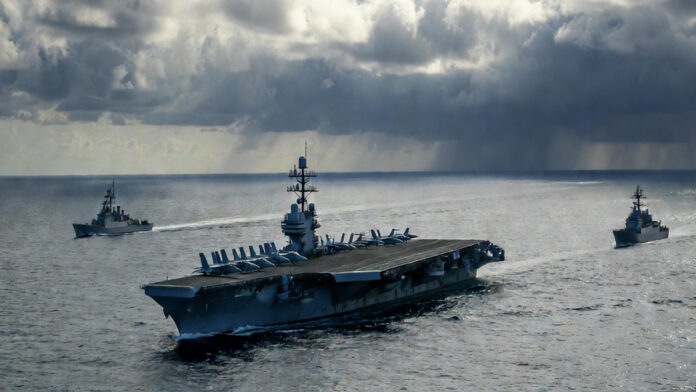
The arrival of the US Navy’s aircraft carrier USS Abraham Lincoln in West Asia has heightened regional tensions, prompting renewed speculation about Washington’s next steps toward Iran, even as protests inside the country have subsided.
While the Iranian government has largely suppressed recent anti-government demonstrations, uncertainty continues to loom amid growing US military presence near Iran’s borders. Analysts note that the deployment appears aimed at applying strategic pressure, though no official announcement of military action has been made.
USS Abraham Lincoln Deployed to West Asia
The USS Abraham Lincoln is one of the most powerful warships in the US Navy. It is a Nimitz-class, nuclear-powered aircraft carrier and serves as the flagship of Carrier Strike Group 3.
According to US defense updates, the carrier passed through the Malacca Strait on January 19 before entering the West Asia region.
Accompanying the carrier are three Arleigh Burke–class guided missile destroyers:
USS Frank E. Petersen Jr.
USS Spruance
USS Michael Murphy
The US Central Command (CENTCOM) confirmed the deployment in a social media post, stating that the carrier strike group has been positioned in West Asia as part of regional security operations.
Additional US Military Assets Deployed
Along with the naval deployment, the United States has also positioned fighter jets and cargo aircraft in areas surrounding Iran. Defense observers view this move as part of a broader strategy to signal military readiness and deter escalation.
Earlier, US President Donald Trump stated in a social media post that a large naval force was moving toward Iran, while adding that it might not ultimately be used.
Iran Protests and Human Rights Concerns
Iran witnessed widespread protests in December, driven by rising inflation and a worsening economic situation. Reports from opposition sources claim that more than 6,000 people were killed during the crackdown, though these figures have not been independently verified.
The Iranian government had reportedly prepared to carry out death sentences against several protesters, but the executions were temporarily postponed following warnings from the United States.
Amid mounting pressure, Iranian officials have stated that they do not seek war, but warned that any US attack would be met with a strong response.
Situation Remains Tense
Despite a relative calm on Iran’s streets, the geopolitical situation remains fragile. Diplomatic channels remain active, while military movements continue to be closely monitored by regional and global observers.