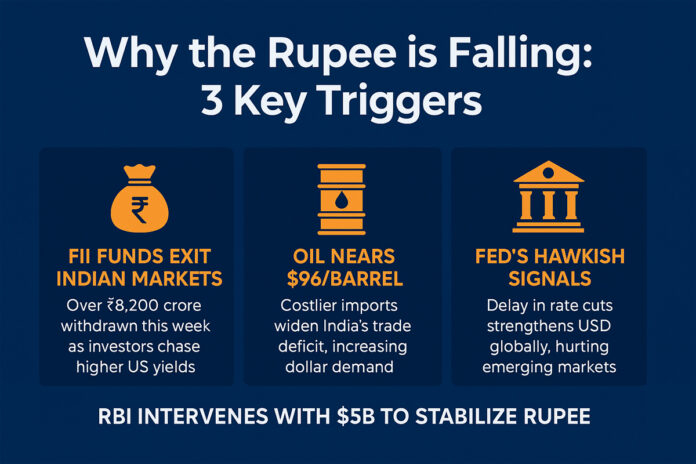
The Indian rupee hit a record low of ₹85.50 against the US dollar on Wednesday, pressured by foreign institutional investor (FII) outflows, rising global crude oil prices, and hawkish signals from the US Federal Reserve. The Reserve Bank of India (RBI) reportedly sold $5 billion from its forex reserves to curb excessive volatility in the currency markets.
📉 FII Outflows Pressure the Market
Foreign investors have been pulling out funds from Indian equities amid expectations that the US Federal Reserve may delay rate cuts, boosting the dollar’s strength globally. According to provisional data, FIIs withdrew over ₹8,200 crore from domestic markets in the past week.
🛢️ Oil Spike Adds to Currency Weakness
Brent crude prices climbed above $96 per barrel, worsening India’s trade deficit outlook and adding pressure on the rupee. As India imports over 80% of its oil needs, higher global prices often translate into increased demand for US dollars, further weakening the local currency.
🏦 RBI Steps In to Stabilize Markets
Traders said the RBI sold around $5 billion from its reserves through state-run banks to arrest the sharp slide. The central bank’s intervention helped the rupee recover marginally to ₹85.25 per USD in late trade.
Analysts note that while the RBI may continue to defend the currency, sustained external pressure could test its tolerance levels near ₹85.75–₹86 in the short term.
💬 Expert View
“Given the Fed’s hawkish tone and risk-off sentiment globally, we expect the rupee to stay under pressure,” said Mehul Shah, Senior FX Analyst at Kotak Securities. “However, RBI’s active management should prevent any runaway depreciation.”
Conclusion (for Discover & Voice Search):
The rupee’s fall highlights India’s growing sensitivity to global monetary shifts and energy prices. With the next Fed policy review due later this month, traders will closely watch for any signs of easing in the dollar rally.