Tehran, Iran – June 11, 2026
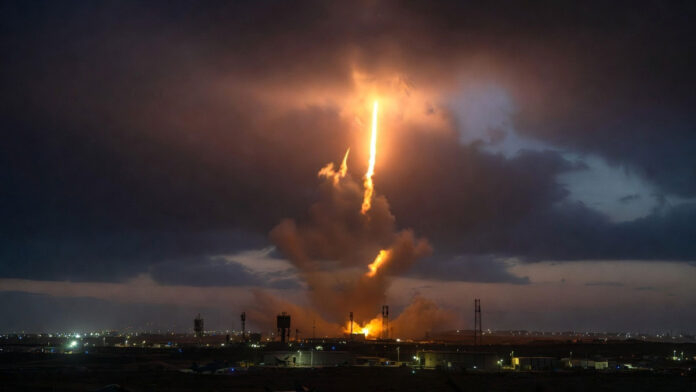
Iran Missile Strikes on US Military Bases have become the latest flashpoint in the rapidly escalating confrontation between Tehran and Washington, after Iran’s Islamic Revolutionary Guard Corps (IRGC) claimed it launched a large-scale ballistic missile operation targeting American military facilities and fighter aircraft deployment sites across the Middle East.
According to statements released by the IRGC, the operation involved 12 ballistic missiles aimed at locations allegedly used by US military forces, including bases associated with the deployment of advanced American fighter aircraft such as the F-35, F-15, and F-16.
The claims were reported by Iranian state-linked media outlets and come amid rising tensions following recent US military operations targeting Iranian-linked assets and infrastructure.
IRGC Claims Multiple US Military Facilities Were Targeted
In a statement issued by its public relations department, the IRGC said the missile operation was carried out in retaliation for recent American military actions.
According to the statement, the IRGC Aerospace Force launched 12 ballistic missiles during the early hours of Thursday. Iranian officials claimed that the missiles targeted military facilities where US F-35, F-15, and F-16 fighter aircraft were stationed, along with command and control centers linked to American military operations.
Among the locations cited by Iranian media was the Al-Azraq Air Base in Jordan, which the IRGC alleged was one of the primary targets of the operation.
Iranian authorities further claimed that significant damage was inflicted on military infrastructure and that multiple aircraft were destroyed during the strikes.
However, independent verification of these claims was not immediately available, and no official confirmation regarding the reported destruction of aircraft had been released by US authorities at the time of reporting.
Five Regional Military Installations Reportedly Targeted
According to reports carried by Iranian state broadcaster IRIB, Iranian armed forces claimed to have targeted five military sites across the region.
The facilities identified by Iranian media include:
- Muwaffaq Al-Salti Air Base in Jordan
- Ahmad Al-Jaber Air Base in Kuwait
- Ali Al-Salem Air Base in Kuwait
- Headquarters of the US Fifth Fleet in Bahrain
- Sheikh Isa Air Base in Bahrain
Iranian officials described the operation as a direct response to military actions carried out by the United States earlier in the week.
The reported targets represent some of the most strategically important facilities used by US forces and allied military operations in the Middle East.
US Military Action Triggered Escalation
The latest exchange follows American military operations conducted on Wednesday evening.
According to the US Central Command (CENTCOM), additional strikes were carried out against targets inside Iran under what US officials described as self-defense measures.
CENTCOM stated that the actions were undertaken following directives from President Donald Trump and were intended to address what Washington characterized as ongoing threats and aggressive activities linked to Iran.
US officials have maintained that the operations were designed to protect American personnel, military assets, and regional security interests.
The military actions further intensified an already volatile security environment across the Middle East.
Trump Administration Signals Continued Pressure
President Donald Trump and Defense Secretary Pete Hegseth have both indicated that military and economic pressure on Tehran could increase if progress is not made toward a new nuclear agreement.
US officials have repeatedly emphasized concerns regarding Iran’s nuclear activities, regional influence, and support for armed groups operating throughout the Middle East.
Washington has argued that stronger measures may be necessary to prevent further escalation and to protect American interests in the region.
Iran, meanwhile, has rejected external pressure and maintains that its actions are defensive responses to what it views as American aggression.
CENTCOM Cites Ongoing Iranian Activities
In its statement, CENTCOM said the recent operations were carried out in response to what it described as Iran’s continued and unprovoked hostile actions.
The command also reported that US forces had intercepted another oil tanker allegedly transporting Iranian oil in violation of restrictions imposed under a US-led enforcement regime.
The tanker seizure further heightened tensions between the two countries and added to the growing list of disputes involving maritime security, sanctions enforcement, and regional military activity.
Shipping routes in the Gulf region remain under close monitoring by international observers as concerns over potential disruptions continue to rise.
Regional Security Concerns Intensify
The latest developments have raised concerns among regional governments and international security analysts about the possibility of a broader military confrontation.
Military facilities in Jordan, Kuwait, Bahrain, and other Gulf states play critical roles in supporting US operations throughout the Middle East. Any attack on these installations carries significant implications for regional security and international military cooperation.
Analysts warn that continued exchanges between Tehran and Washington could increase instability across a region already affected by multiple geopolitical conflicts.
The strategic importance of air bases, naval headquarters, and logistics hubs targeted in the reported attacks underscores the potential consequences of any prolonged military escalation.
Verification Challenges Remain
While Iran has asserted that its missile operation caused extensive damage and destroyed multiple US fighter aircraft, independent confirmation has not yet emerged.
Neither US defense officials nor host nations where the facilities are located had publicly verified the extent of any damage at the time of publication.
As a result, many of the operational claims remain subject to further assessment and verification by military authorities and international observers.
Middle East Tensions Enter New Phase
The reported missile strikes and subsequent claims by the IRGC mark another significant escalation in the ongoing confrontation between Iran and the United States.
With both sides exchanging accusations and military actions, concerns are growing over the risk of a wider regional conflict involving strategic military installations, energy infrastructure, and international shipping routes.
As developments continue to unfold, governments across the region and around the world are closely monitoring the situation for signs of further escalation or potential diplomatic engagement aimed at reducing tensions.
Note: The claims regarding damage to military facilities and aircraft are based on statements issued by Iranian authorities and had not been independently verified at the time of publication.
Source: Statements released by Iran’s Islamic Revolutionary Guard Corps (IRGC), reports from Iranian state media including IRNA and IRIB, and public statements from US Central Command (CENTCOM).