
New Delhi, India — February 17, 2026
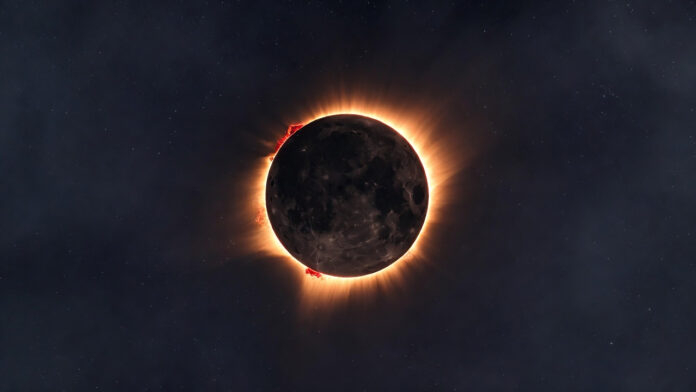
A solar eclipse on February 17, 2026, marks one of the year’s significant astronomical events. According to astrologer Pandit Ajay Kaushik, an eclipse occurs when the Sun, Moon, and Earth align in a straight line and the Moon partially or completely blocks sunlight from reaching Earth.
While eclipses are primarily scientific phenomena, they also hold cultural and astrological importance in many traditions. Observers worldwide are preparing for the event, though it will not be visible from India.

Eclipse Timing on February 17, 2026
The solar eclipse is scheduled to occur on Phalguna Amavasya according to the Hindu calendar.
Start: 5:26 PM IST
End: 7:57 PM IST
Despite its significance, the eclipse will not be visible in India, as the alignment will occur when the Sun is below the horizon.
Will Sutak Period Apply?
Traditional beliefs state that a Sutak period begins about 12 hours before a solar eclipse, during which certain activities — such as religious rituals, travel, or starting new ventures — are avoided.
However, astrologers note that since this eclipse will not be visible in India, the Sutak period is generally considered not applicable there.
Where the Eclipse Will Be Visible
The celestial event will be observable mainly in parts of the Southern Hemisphere, including:
Antarctica
Argentina
Chile
South Africa
Botswana
Namibia
Zimbabwe
Zambia
Tanzania
Madagascar
Mauritius
Mozambique
Several island territories in the southern oceans may also witness partial or annular phases.
Scientific Significance
According to NASA, solar eclipses occur because of the precise distances and sizes of Earth, Moon, and Sun. Even slight variations in orbital positions determine whether an eclipse is total, partial, or annular.
Such events help scientists study solar radiation, atmospheric light effects, and orbital mechanics.
Cultural & Observational Interest
Even though India will not see the eclipse directly, enthusiasts can watch it via live streams from observatories and space agencies, which typically broadcast high-resolution telescope views.
Astronomers emphasize that eclipses offer valuable opportunities to observe celestial alignment and understand the dynamics of the solar system.
Feb 17 Solar Eclipse — Key Facts
🕔 Starts: 5:26 PM IST
🕗 Ends: 7:57 PM IST
🇮🇳 India: Not visible
🌍 Visible: Southern Hemisphere
📌 Sutak rule: Not applicable in India
Bottom line: Rare celestial event globally, but Indian skywatchers must watch online.