
New Delhi, November 5, 2025:
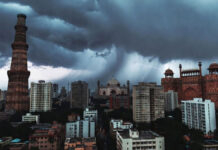
Delhi-NCR woke up to a toxic haze on Tuesday, with the post-Diwali air quality index (AQI) spiking to 450, placing it firmly in the “severe” category. The smog blanketed major areas like Anand Vihar, Noida, and Gurugram, prompting emergency public health measures, including school closures and odd-even vehicle restrictions.
According to data from the Central Pollution Control Board (CPCB), particulate matter levels (PM2.5 and PM10) were recorded at nearly 10 times higher than safe limits, making the air unfit for even healthy individuals. Visibility dropped sharply during morning hours, disrupting road traffic and flight operations at Delhi Airport.
🔥 Firecracker Ban Flouted
Despite a Supreme Court ban on firecrackers, several areas in Delhi and nearby cities witnessed widespread violations. Videos on social media showed fireworks lighting up the sky late into the night, worsening pollution levels.
The Supreme Court of India, taking suo motu cognizance, slammed both the Delhi government and law enforcement agencies for failing to enforce the ban.
“Every year, we issue directions, and every year they are ignored. Is this just a ritual now?” — remarked Justice Sanjay Kishan Kaul during the special hearing.
🚸 Schools Closed, Odd-Even Rule Back
The Delhi government announced that all schools will remain shut until further notice, and advised residents to work from home wherever possible. Starting Thursday, the odd-even vehicle scheme will return to curb vehicular emissions — a move that officials hope will bring temporary relief.
Environment Minister Gopal Rai said,
“We are implementing all emergency measures, including artificial rain experiments, to disperse pollutants. Citizens must cooperate for Delhi to breathe again.”
🌍 Regional Impact Across NCR
Neighboring cities such as Gurugram, Noida, and Ghaziabad also recorded AQI levels between 420–460, indicating that the smog crisis extended beyond Delhi’s borders. Hospitals across NCR reported a spike in respiratory illness cases, especially among children and the elderly.
⚙️ Green Transition and Long-Term Solutions
Environmentalists urged the government to strengthen long-term air quality policies, including a shift toward renewable energy, better waste management, and stricter construction dust controls.
“We cannot continue to blame Diwali alone — it’s a cumulative failure of urban planning and industrial regulation,” said Anumita Roychowdhury of the Centre for Science and Environment (CSE).