New York | March 2, 2026
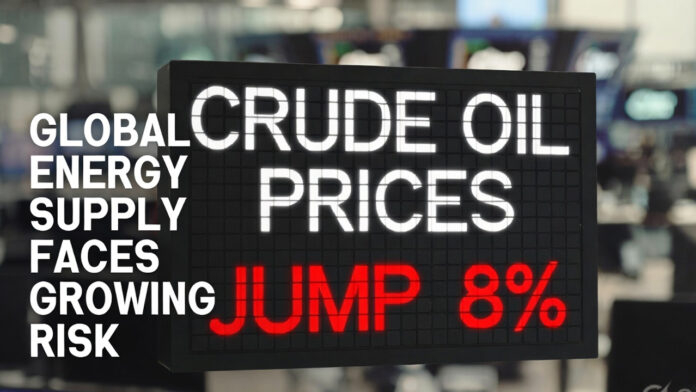
Global oil markets surged sharply after renewed military escalation in West Asia triggered fresh concerns over energy supply disruptions. Following reported strikes involving United States and Israel against Iran — and subsequent retaliatory actions — traders reacted swiftly, pushing crude prices higher amid fears of a prolonged conflict.
Energy analysts say the primary market concern is not only production levels but the safety of key shipping routes critical to global oil distribution.
U.S. Crude Oil Climbs 8%
U.S. benchmark crude, West Texas Intermediate (WTI), climbed to nearly $72 per barrel — up from approximately $67 on Friday — marking an increase of about 8%.
Market participants indicated that if tensions intensify further, oil prices could continue to rise. Brent crude futures also showed upward momentum as investors priced in geopolitical risk premiums.
Strait of Hormuz Emerges as Critical Flashpoint
The most significant risk factor remains the strategically vital Strait of Hormuz — a narrow maritime corridor connecting the Persian Gulf to global markets.
Roughly 15 million barrels of crude oil pass through this route daily, accounting for nearly 20% of the world’s oil supply. Major energy exporters including Saudi Arabia, Kuwait, Iraq, Qatar, Bahrain, United Arab Emirates, and Iran rely on this passage to transport oil and gas.
Recent reports of attacks on vessels transiting the area have intensified market anxiety. Analysts warn that any sustained disruption to shipping could significantly impact global exports and drive up gasoline and diesel prices worldwide.
OPEC+ Announces Output Increase
In response to rising uncertainty, the OPEC+ alliance announced that eight member countries will increase production by 206,000 barrels per day starting in April.
The participating nations include Saudi Arabia, Russia, Iraq, the United Arab Emirates, Kuwait, Kazakhstan, Algeria, and Oman.
While the move is aimed at stabilizing markets, energy experts caution that increased production alone may not offset supply risks if maritime routes remain vulnerable.
Iran’s Exports and China’s Exposure
Iran exports approximately 1.6 million barrels of oil per day, with a significant share going to China. If Iranian exports are disrupted due to military escalation or logistical constraints, major importers may be forced to seek alternative suppliers, potentially at higher prices.
Such shifts could tighten global supply-demand balances and amplify price volatility across energy markets.
Broader Economic Implications
Economists note that prolonged instability in West Asia could extend beyond oil markets, influencing inflation rates, transportation costs, and stock market performance globally.
As energy remains a cornerstone of industrial and consumer activity, sustained price increases could have ripple effects across manufacturing, logistics, and household fuel expenses.
With geopolitical developments evolving rapidly, traders and policymakers continue to monitor both diplomatic signals and shipping activity in one of the world’s most critical energy corridors.