NEW DELHI, India — June 1, 2026
June Rule Changes 2026 have officially come into effect, bringing several important updates that could impact the daily lives and financial planning of millions of Indians. From digital payments and tax compliance to rising car prices and stricter solar panel regulations, the new rules introduced from June 1 are expected to influence consumers, businesses, and investors alike.
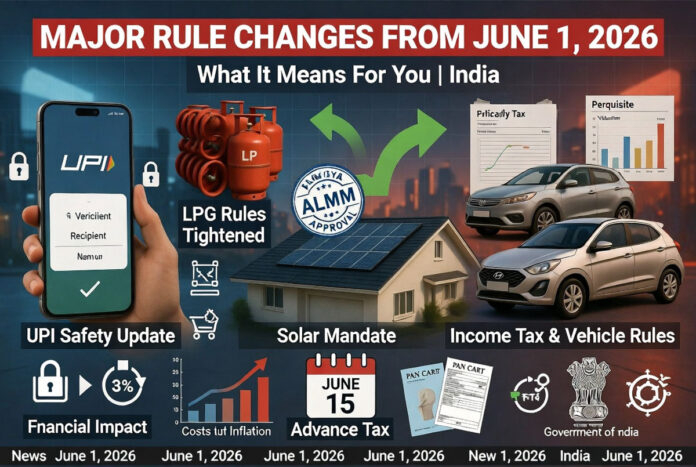
The latest changes include enhanced transparency in UPI transactions, the upcoming deadline for advance tax payments, price hikes from leading automobile manufacturers, stricter compliance requirements for solar installations, and possible revisions in fuel prices.
Here is a detailed look at the five major changes that have come into effect this month.
UPI Transactions to Become More Transparent
One of the most significant changes affects Unified Payments Interface (UPI) users.
Under the updated system, users making UPI payments will now be able to view the recipient’s actual bank-registered name before completing a transaction. The move is aimed at improving transparency, reducing fraud risks, and helping users verify payment details before sending money.
The enhanced verification process is expected to strengthen trust in digital payments and minimize mistaken transfers.
Advance Tax First Installment Due by June 15
June is also an important month for taxpayers.
The first installment of advance tax for the financial year 2026-27 must be paid by June 15, 2026. Individuals and businesses with an estimated annual tax liability exceeding ₹10,000 are required to pay at least 15 percent of their total advance tax liability by the deadline.
Failure to comply may result in interest penalties under the Income Tax Act.
Tax experts recommend calculating liabilities early to avoid last-minute complications and additional charges.
Maruti Suzuki and Hyundai Cars Become More Expensive
Consumers planning to purchase a new vehicle may have to pay more from June 1.
Leading automakers Maruti Suzuki and Hyundai Motor India have announced price increases across several models.
Maruti Suzuki has increased prices by up to ₹30,000, depending on the model and variant. The company cited rising input costs, inflationary pressures, and higher manufacturing expenses as key reasons behind the revision.
Hyundai Motor India has also raised prices across its vehicle portfolio by up to ₹12,800, attributing the increase to higher raw material, commodity, and operational costs.
The revised prices are effective immediately.
Stricter Solar Panel Rules Come Into Force
The government has introduced stricter compliance requirements for solar energy installations from June 1, 2026.
Under the new regulations, only solar panels and solar cells listed under the Approved List of Models and Manufacturers (ALMM) will be eligible for use in government-supported solar projects, subsidy programs, and net-metering systems.
The measure is intended to improve quality standards, promote domestic manufacturing, and ensure greater reliability in India’s renewable energy sector.
Consumers and businesses planning to install solar systems under government schemes will need to ensure that their equipment meets ALMM requirements.
Fuel Prices May See Monthly Revision
Fuel prices remain another area closely watched by consumers.
Oil marketing companies typically review petrol, diesel, and LPG prices at the beginning of each month. As part of the regular monthly review process, revised rates may be announced based on international crude oil trends, currency fluctuations, and domestic market conditions.
Any changes in fuel prices could affect transportation costs, household budgets, and business operations across multiple sectors.
What These Changes Mean for Consumers
The June 2026 rule changes reflect ongoing efforts to improve transparency in financial transactions, strengthen tax compliance, encourage quality standards in renewable energy, and adjust pricing structures in response to market conditions.
While UPI users may benefit from greater payment security and transparency, consumers planning to buy vehicles could face higher costs. Taxpayers must also remain aware of advance tax deadlines to avoid penalties. At the same time, businesses in the renewable energy sector will need to adapt to the updated ALMM compliance framework.
As these changes take effect nationwide, consumers and businesses are advised to review their financial plans and stay informed about future regulatory updates.