Washington DC, United States – May 28, 2026
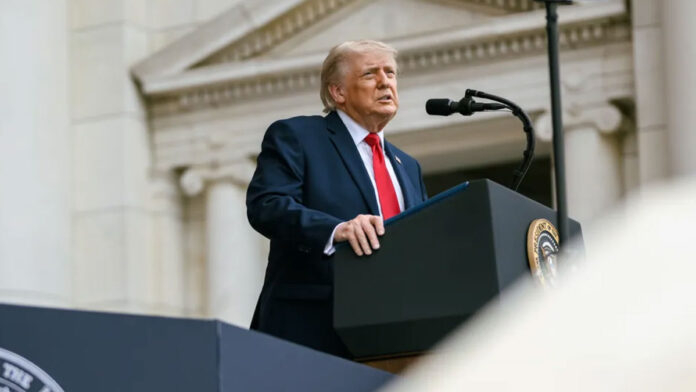
Global attention remains fixed on Washington and Tehran as rising tensions in West Asia continue to fuel fears of a wider geopolitical crisis. Amid ongoing diplomatic negotiations, US President Donald Trump stated that Iran is eager to reach an agreement with the United States, but warned that Washington is still not satisfied with the current proposal and could consider military action if talks fail.
The remarks came during a high-level cabinet meeting at the White House, where Trump indicated that negotiations are continuing behind closed doors. However, uncertainty surrounding the Hormuz Strait, global oil supply routes, Iran’s nuclear program, and regional ceasefire efforts has intensified concerns across international markets and diplomatic circles.
What Major Message Did Trump Give on Iran?
During the cabinet meeting, Trump claimed that Iran is currently under immense pressure and has very limited options apart from negotiating with the United States.
He stated, “Iran wants a deal very badly. Discussions are ongoing, but we are not fully satisfied yet. If we are not satisfied, we will take action.”
Trump also dismissed speculation that the United States might soften its position due to domestic political pressure or upcoming elections. According to him, Iran had expected Washington to retreat under electoral pressure, but that assumption was incorrect.
He emphasized that US foreign policy and strategic decisions would not be influenced by election politics.
Was There a Secret Agreement Between the US and Iran?
Iranian state media recently claimed that both countries had already prepared a preliminary draft agreement aimed at reducing tensions in the Gulf region.
According to those reports, the proposed framework allegedly included:
- Removal of US naval restrictions against Iran
- Reduction of American military presence in the Gulf
- Restoration of normal commercial shipping through the Hormuz Strait
However, the White House strongly rejected these claims and described the reported agreement as “completely fake.”
US vs Iran Claims on Key Issues
| Issue | US Position | Iran’s Claim |
|---|---|---|
| Naval blockade | Refused removal | Claimed restrictions may end |
| Military withdrawal | No confirmation | Claimed Gulf troop reduction |
| Hormuz Strait | Monitoring continues | Trade movement to normalize |
| Draft agreement | Called fake | Claimed preliminary understanding |
The conflicting narratives have further increased uncertainty regarding the actual status of negotiations.
What Did Secretary Rubio Say About the Talks?
US Secretary of State Marco Rubio acknowledged that some progress had been made during discussions with Iran, but clarified that a final agreement had not yet been reached.
Rubio stressed that the coming hours and days would be extremely critical for diplomacy in the region.
Key Points From Rubio’s Statement
- Some progress has been achieved in negotiations with Iran
- No final agreement has been signed yet
- The next few days are extremely important
- The US will not rush into any weak compromise
- Iran must take concrete and verifiable steps
- Security of the Hormuz Strait remains the top priority
- America will not compromise on the safety of its allies
- Sanctions relief is impossible without regional stability
His comments reflected Washington’s cautious approach despite ongoing diplomatic engagement.
Why Is the Hormuz Strait So Important?
The Hormuz Strait is considered one of the world’s most strategically important maritime trade routes. A significant portion of global crude oil exports passes through this narrow waterway connecting the Persian Gulf to international markets.
Any escalation in tensions around the Hormuz Strait directly impacts:
- Global oil prices
- International shipping routes
- Energy security
- Financial markets
- Inflation and trade costs worldwide
Recent geopolitical uncertainty has already triggered sharp fluctuations in crude oil prices, with investors closely monitoring every statement from Washington and Tehran.
Iran’s Nuclear Program Remains the Biggest Obstacle
One of the central disputes in the negotiations continues to be Iran’s uranium enrichment program.
The United States wants Iran to eliminate its stockpile of highly enriched uranium, which Washington considers a major security threat.
According to international reports, Iran currently possesses approximately 440.9 kilograms of uranium enriched up to 60 percent purity, a level considered dangerously close to weapons-grade capability.
Although Iran has not publicly agreed to abandon its enriched uranium reserves, diplomatic sources suggest that a possible agreement could involve:
- Reduction of uranium stockpiles
- International monitoring mechanisms
- Partial sanctions relief for Iran
However, major disagreements still remain unresolved.
Israel-Hezbollah Conflict Adds More Pressure
The ongoing tensions involving Israel, Lebanon, and Hezbollah have further complicated diplomatic efforts.
Iran reportedly wants Lebanon included in any broader ceasefire arrangement, while Israel has maintained a hardline security position.
Israeli leadership has warned that it will not tolerate any threat to national security and has signaled the possibility of expanding military operations in Lebanon if necessary.
This has increased fears that any collapse in US-Iran diplomacy could trigger wider regional instability involving multiple actors across West Asia.
Discussion Around Trump’s Abraham Accords Plan
During the cabinet meeting, Trump also revived discussion around expanding the Abraham Accords framework.
He expressed interest in bringing countries such as:
- Saudi Arabia
- Qatar
- Kuwait
- Pakistan
into the normalization initiative originally designed to improve relations between Israel and Arab nations.
However, several Arab countries continue to insist that recognition of a Palestinian state remains a key condition before broader normalization can move forward.
As a result, consensus on expanding the Abraham Accords still appears distant.
Global Impact of the US-Iran Crisis
The ongoing confrontation between the United States and Iran is no longer viewed as a bilateral dispute alone. Its consequences are being felt across:
- Global oil markets
- International trade routes
- Middle East security dynamics
- Energy supply chains
- Worldwide economic stability
While the Trump administration continues projecting confidence and strategic strength, Iran also appears unwilling to retreat despite mounting pressure.
Conclusion
The US-Iran Tensions 2026 crisis has entered a highly sensitive phase as diplomatic negotiations continue alongside growing military threats and geopolitical uncertainty. Trump’s latest remarks suggest that Washington still hopes for a deal, but remains prepared for stronger action if talks collapse.
With the Hormuz Strait, Iran’s nuclear ambitions, Israel-Hezbollah tensions, and global oil markets all interconnected, the coming days could prove decisive not only for the Middle East but for the broader global economy as well.
Stay tuned for the latest updates on US-Iran negotiations, Middle East tensions, oil market reactions, and global diplomatic developments.