New Delhi, India — May 21, 2026
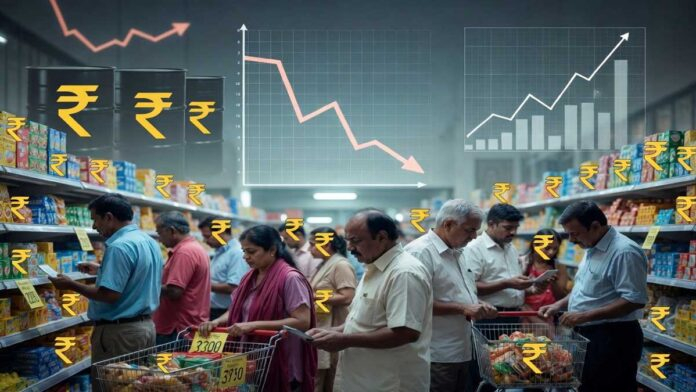
India’s economic growth outlook is facing fresh pressure as rising inflation, weak consumer spending, expensive crude oil, and concerns over a weaker monsoon threaten to slow demand across key sectors of the economy.
Economists and market analysts warn that any sustained decline in household consumption could significantly impact India’s growth momentum, particularly at a time when the country is already navigating global geopolitical tensions, volatile energy prices, foreign capital outflows, and a weakening rupee.
Consumer spending remains the backbone of India’s economy. From rural grocery stores to urban shopping malls, household demand continues to drive economic activity across sectors.
Consumption Remains the Core Driver of India’s Economy
Private consumption accounts for nearly 57% of India’s Gross Domestic Product, making domestic spending the single largest contributor to economic growth.
Data from the December 2025 quarter showed private consumption rising to 57.5% of GDP, underlining the critical role of household confidence and purchasing power in sustaining economic momentum.
However, concerns have intensified after multiple agencies lowered India’s growth forecasts over the past three months.
The United Nations reduced India’s 2026 growth projection from 6.6% to 6.4%, citing external risks and slowing demand conditions.
Meanwhile, Moody’s Ratings cut its India growth estimate for 2026 from 6.8% to 6.0%.
India Ratings and Research also projected India’s growth rate at 6.7% for 2026-27, highlighting risks linked to West Asia tensions and potential El Niño weather disruptions.
Despite remaining one of the world’s fastest-growing major economies, analysts say India is increasingly vulnerable to global economic shocks and domestic inflationary pressures.
FMCG Demand Emerging as a Key Warning Signal
The fast-moving consumer goods (FMCG) sector, often considered the clearest indicator of household consumption trends, is beginning to show signs of moderation.
Everyday products such as soap, edible oil, biscuits, tea, shampoo, and packaged foods typically provide early insights into consumer demand patterns.
According to data from Worldpanel by Numerator, FMCG value growth stood at 13.1% in the January–March quarter, while volume growth was recorded at 5.4%.
The agency estimates that FMCG volume growth could remain near 5% in 2026 if crude oil prices stabilize and the monsoon performs normally.
However, if inflationary pressures persist and weather conditions deteriorate, FMCG growth could slow sharply to 3%–4%.
Consumers Shifting Toward Lower-Cost Products
Analysts note that during periods of inflation, consumers typically postpone non-essential purchases, shift from premium brands to lower-cost alternatives, and prefer larger value packs to maximize savings.
For companies, this trend presents a major challenge as revenue growth driven purely by price increases may not be sustainable without corresponding volume expansion.
Market experts say the real test for consumer-facing companies will now be maintaining sales volumes rather than relying solely on higher product pricing to boost revenues.
Weak Monsoon and High Crude Oil Prices Add to Risks
India’s consumption outlook is also closely tied to weather conditions and global energy markets.
According to the U.S. National Oceanic and Atmospheric Administration, there is an 82% probability of El Niño conditions emerging between May and July 2026, with a 96% chance of those conditions continuing into winter.
Initial projections from the India Meteorological Department suggest that the southwest monsoon could remain weaker than normal.
A poor monsoon could directly affect:
- Food grain production
- Vegetable and dairy prices
- Rural wages
- Livestock feed costs
- Rural consumption demand
At the same time, elevated crude oil prices continue to increase transportation, packaging, and manufacturing costs, further fueling inflationary pressures across sectors.
Broader Economic Impact May Extend Beyond FMCG
Experts caution that if consumption growth weakens further, the impact will not remain limited to the FMCG industry alone.
Several sectors could face pressure, including:
- Automobiles
- Cement
- Textiles
- Electronics
- Small businesses
- Employment generation
- GST collections
With consumer demand acting as the central engine of India’s economy, policymakers and businesses are closely monitoring inflation trends, energy prices, and monsoon developments over the coming months.