Tehran, Iran — March 4, 2026
The conflict in the Middle East has intensified as military exchanges between Iran, Israel, and the United States continued for the fifth consecutive day. Airstrikes and retaliatory attacks have escalated across the region, raising fears of a broader regional war.
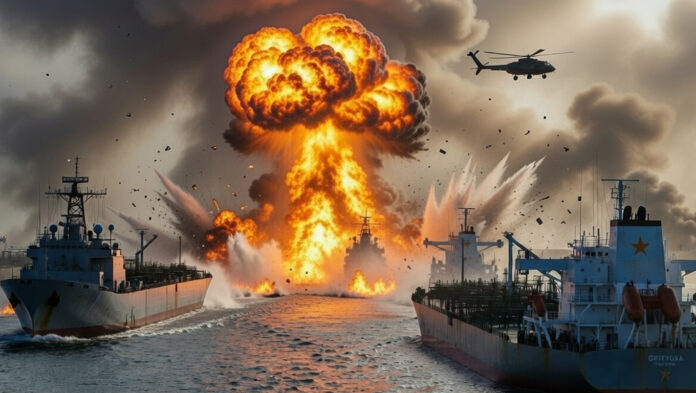
Amid the growing tensions, Iran’s Islamic Revolutionary Guard Corps (IRGC) claimed on Wednesday that it has “full control” over the Strait of Hormuz, one of the world’s most critical oil shipping routes.
Iran Claims Control of Strategic Waterway
Iranian Revolutionary Guard officials said that their naval forces currently maintain complete control over the Strait of Hormuz, a narrow passage through which a significant portion of global oil supplies travels.
According to a statement reported by Iranian media, IRGC naval officer Mohammad Akbarzadeh warned that ships moving through the strait could face missile or drone attacks during the ongoing conflict.
The statement has raised concerns among global energy markets, as disruptions in the Strait of Hormuz could affect international oil supplies and shipping routes.
Earlier, US President Donald Trump stated that the US Navy is prepared to escort oil tankers through the strait to ensure safe passage for international shipping.
Intensifying Military Operations
The US military has reported conducting around 2,000 strikes across Iran since Saturday, targeting military installations and strategic infrastructure.
According to US officials, these operations have resulted in the destruction of 17 Iranian vessels, including a submarine.
Meanwhile, explosions continued to be reported for the fourth consecutive night in several Iranian cities, including Tehran, as Iranian forces pledged to continue retaliatory operations.
Attacks Spread Across the Region
The conflict is increasingly affecting multiple countries across the Middle East.
Israel intensified strikes in Lebanon, with attacks reported in Baalbek, Aramoun, and Saadiyat, where residential buildings were hit.
At least 10 people were reported killed in these attacks, and a hotel in Hazmieh was also targeted.
Iran launched retaliatory missile and drone strikes across the region.
Kuwait reported the death of a child, while Saudi Arabia said it intercepted two missiles and nine drones.
Military activity has also been reported in Iraq, where an Iran-aligned Popular Mobilization Forces headquarters in western Al-Qaim was targeted.
Additionally, a drone attack reportedly struck a US logistics support facility near Baghdad International Airport, according to regional media reports.
Israel Intercepts Rockets from Lebanon
The Israeli military reported detecting several rockets launched from Lebanese territory within the past hour.
Most of the missiles were intercepted by Israel’s air defense systems, though one reportedly landed in an open area without causing major damage.
Saudi Arabia Intercepts Missiles
Saudi Arabia’s Ministry of Defense said it intercepted and destroyed two cruise missiles over Al-Kharj province, preventing potential damage on the ground.
Russia and China Criticize Attacks on Iran
The escalation has drawn strong reactions from major global powers.
China’s top diplomat Wang Yi called on Israel to immediately halt military operations, while Russia’s Foreign Minister Sergey Lavrov criticized the strikes and said Moscow had seen no evidence that Iran was attempting to develop nuclear weapons.
Evacuation Preparations for US Citizens
As the situation continues to deteriorate, the US Department of Homeland Security and other agencies have reportedly begun preparations to assist Americans who wish to leave parts of the Middle East.
President Trump has indicated that the military campaign could continue for several weeks, further raising concerns about prolonged instability in the region.
With military operations expanding across multiple countries, global leaders are closely monitoring the situation as diplomatic efforts struggle to contain the escalating conflict.