WASHINGTON — June 26, 2026
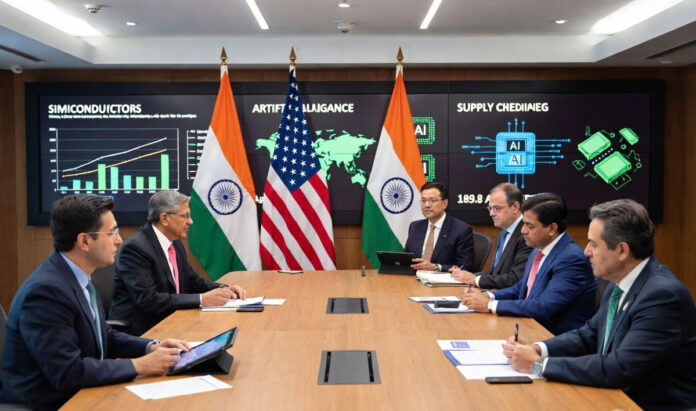
India US semiconductor AI talks moved into sharper focus this week after senior officials from both countries held high-level discussions in Washington on expanding cooperation in semiconductor manufacturing, artificial intelligence, resilient supply chains, and access to critical minerals — four sectors increasingly seen as central to economic security and next-generation industrial growth.
According to a statement shared by the Embassy of India in Washington, S. Krishnan, Secretary in India’s Ministry of Electronics and Information Technology (MeitY), met Jacob S. Helberg, the U.S. Under Secretary of State for Economic Affairs, to explore ways to strengthen bilateral technology cooperation across strategic sectors. The discussions centered on building more diversified and trusted supply chains, especially in semiconductors and AI adoption, while also examining ways to secure reliable access to critical minerals essential for advanced manufacturing and clean-energy technologies.
The Indian Embassy said in its social media update that the meeting was aimed at “further strengthening bilateral technology cooperation,” underscoring how rapidly the U.S.-India technology relationship is expanding beyond broad political alignment into specific industrial priorities.
Talks come as India and the US step up tech coordination under Pax Silica
The Washington meeting comes against the backdrop of growing cooperation under Pax Silica, the U.S.-led initiative focused on creating secure, diversified, and trusted supply chains in semiconductors, AI infrastructure, critical minerals, and related strategic technologies. India formally joined the initiative earlier this year during the India AI Impact Summit, marking a significant step in the broader technology alignment between New Delhi and Washington.
The latest round of talks suggests both sides are now moving from framework-level announcements to more operational conversations around how that cooperation will work in practice. In Washington, officials discussed not only chip manufacturing and AI adoption, but also the architecture of supply chain resilience — a critical issue at a time when geopolitical disruptions, export controls, and overdependence on a limited number of countries for key materials have exposed vulnerabilities across the global tech ecosystem.
That matters because semiconductors and AI are no longer being treated as just commercial sectors. They are increasingly tied to national security, industrial competitiveness, digital infrastructure, defense capabilities, and the future of high-value manufacturing. For both India and the United States, reducing strategic dependence on concentrated supply networks — especially where China dominates minerals processing or electronics manufacturing inputs — has become a core policy goal.
Why critical minerals are now part of the semiconductor and AI conversation
One of the most important aspects of the talks was the focus on critical minerals, a category that includes materials needed for chipmaking, batteries, clean-energy systems, electronics, and advanced defense manufacturing. These minerals have become a geopolitical flashpoint because many supply chains are heavily concentrated, particularly in extraction, processing, and refining.
Officials from India and the U.S. discussed ways to improve access to such minerals as part of a broader push to secure the foundations of future technology production. That is significant because semiconductors and AI hardware do not exist in isolation; they depend on a long chain of upstream inputs ranging from specialty chemicals and rare earths to energy systems, fabrication equipment, and skilled labor.
The strategic logic is straightforward: if India and the U.S. want to build more resilient technology ecosystems, they cannot focus only on software, design, or final-stage manufacturing. They also need reliable access to the raw materials and industrial inputs that make chip fabrication, AI infrastructure, and advanced electronics possible.
India sees a talent opening in the global semiconductor race
The talks also come at a moment when India is trying to position itself not only as a market for electronics and AI adoption, but as a major talent and manufacturing player in the semiconductor industry. Earlier this month, India’s Electronics and IT Minister Ashwini Vaishnaw said the global semiconductor sector is facing a shortage of roughly one million professionals, creating a major opening for India to emerge as a supplier of skilled talent to the industry.
Vaishnaw said the global semiconductor market is currently valued at around $800 billion and is expected to cross the $1 trillion mark within a year. He also projected that by 2032, the sector could generate about one million jobs worldwide, while still facing a comparable shortfall in trained professionals. Those comments have become part of the Indian government’s broader argument that the country can leverage its engineering base, policy incentives, and growing electronics ecosystem to play a much larger role in the global chip economy.
That ambition is directly connected to the U.S. partnership. While the United States remains a global leader in advanced semiconductor design, AI innovation, and frontier technology ecosystems, India is pitching itself as a partner that can contribute scale, engineering talent, market depth, and eventually manufacturing capacity. The Washington talks reflect that strategic complementarity.
A broader shift in the India-US relationship
In practical terms, the latest India US semiconductor AI talks show how the bilateral relationship is evolving beyond traditional diplomacy, defense ties, and trade disputes into something more structurally economic and technological. Supply chain resilience, AI governance, critical minerals, advanced manufacturing, and trusted digital infrastructure are becoming core pillars of the partnership.
That shift is happening at a time when both countries are also trying to insulate themselves from global shocks — whether from geopolitical conflict, shipping disruptions, or the concentration of semiconductor and mineral supply in a handful of countries. For India, closer cooperation with Washington can accelerate access to capital, know-how, and strategic partnerships in sectors it wants to scale domestically. For the United States, India represents a large democratic partner with a growing technology workforce, expanding industrial ambition, and increasing relevance to the future of secure supply chains.
The immediate outcome of this week’s talks may be diplomatic rather than transactional. No major commercial announcement emerged from the meeting itself. But the significance lies in the direction of travel: semiconductors, AI, supply chains, and critical minerals are no longer side conversations in the India-U.S. relationship. They are moving to the center of it.
If that trend continues, the Washington talks could be seen as part of a broader effort to build a more durable technology alliance — one aimed not just at cooperation, but at reshaping how future strategic industries are sourced, staffed, and secured.