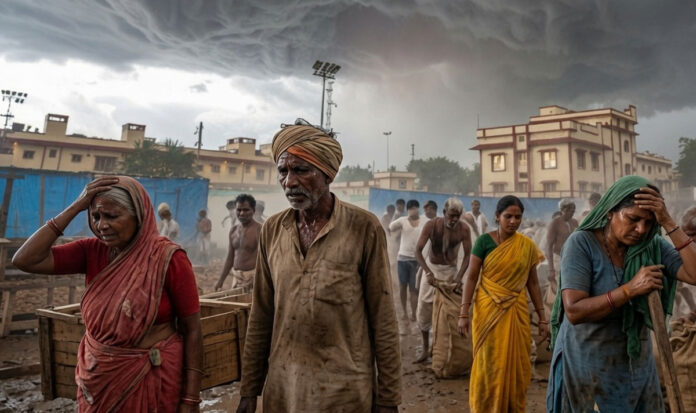
NEW DELHI, India — June 16, 2026
India Monsoon Heat Stress could emerge as one of the country’s most significant climate-related threats in the coming decades, with a new scientific study warning that rising global temperatures may make the monsoon season as dangerous as India’s notorious summer heatwaves.
The research, led by the Indian Institute of Technology (IIT) Gandhinagar, highlights the growing risks associated with a combination of extreme heat and high humidity during the monsoon months. According to the study, if global temperatures rise by 2 degrees Celsius above pre-industrial levels, nearly 53 percent of India’s land area could experience conditions severe enough to threaten human health and safety.
Researchers warn that these conditions could expose hundreds of millions of people to what scientists describe as “uncompensable heat stress” — a dangerous state in which the human body is unable to cool itself effectively through sweating.
Under normal conditions, perspiration helps regulate body temperature by allowing heat to escape as sweat evaporates from the skin. However, when humidity levels become extremely high, sweat cannot evaporate efficiently. As a result, heat accumulates inside the body, increasing the risk of heat exhaustion, heat stroke, organ stress, and potentially fatal health outcomes.
The study suggests that even individuals performing light physical activity could struggle to maintain a safe body temperature during prolonged exposure to these conditions. Scientists say that extended periods of extreme heat combined with elevated humidity can overwhelm the body’s natural cooling mechanisms, creating serious public health concerns.
According to the findings, the threat could intensify significantly if global warming reaches the 2-degree Celsius threshold. During the monsoon season alone, more than half of India’s territory may experience severe heat-humidity events. Researchers also estimate that the danger could expand further during the summer months, potentially affecting nearly 60 percent of the country.
Among the most vulnerable regions identified in the study are the densely populated Gangetic plains, northwestern India, and parts of the eastern coastline. These areas are projected to face some of the highest levels of combined heat and humidity, increasing the likelihood of dangerous environmental conditions.
The study estimates that approximately 700 million people could be exposed to these risks. Outdoor workers are expected to bear the greatest burden. Farmers, construction workers, road-building crews, delivery personnel, and other labor-intensive workers often spend long hours in open environments, making them particularly susceptible to heat-related illnesses.
Researchers note that many workers in these sectors have limited access to cooling infrastructure, shaded workspaces, or protective measures against extreme weather. Consequently, rising heat stress could affect not only public health but also labor productivity, economic output, and livelihoods across several regions.
Climate experts increasingly view extreme heat and humidity as a major challenge for developing economies, where large populations depend on outdoor employment. As temperatures continue to rise globally, policymakers may need to strengthen adaptation measures, improve heat action plans, expand public awareness campaigns, and invest in climate-resilient infrastructure.
The findings add to a growing body of scientific evidence indicating that climate change is reshaping weather patterns across South Asia. While heatwaves have traditionally been associated with the pre-monsoon summer season, researchers now warn that the monsoon period itself may become a significant source of climate-related health risks in the future.
As governments and communities prepare for a warming world, the study underscores the urgent need for long-term strategies to protect vulnerable populations from the combined effects of extreme heat and humidity.