New Delhi, India — March 5, 2026
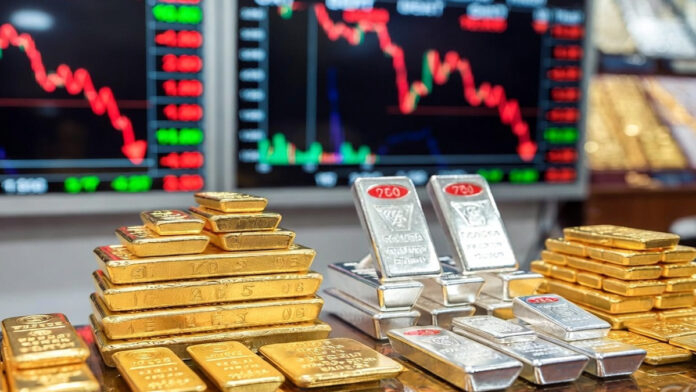
Gold and silver prices witnessed a sharp correction in India’s bullion market on Thursday as trading resumed after the Holi holidays. The steep decline surprised many investors, as both precious metals had recently been trading near record highs.
According to market data from the Delhi bullion market, gold prices dropped by ₹7,600 per 10 grams, while silver saw an even steeper fall of ₹27,700 per kilogram, reflecting significant profit-booking by investors.
How Much Did Gold and Silver Prices Fall?
In New Delhi’s bullion market, 99.9% purity gold fell to ₹1,65,200 per 10 grams, down from ₹1,72,800 in the previous trading session.
Silver prices recorded an even sharper correction. The metal dropped by ₹27,700, or 9.23%, to ₹2,72,300 per kilogram, including taxes.
It is worth noting that bullion markets in India remained closed on Tuesday and Wednesday due to the Holi festival, and Thursday marked the first trading session after the holiday break.
Why Did Prices Drop So Sharply?
Market experts and the All India Sarafa Association attributed the sharp decline primarily to heavy profit-booking after a strong rally in recent weeks.
Investors who had accumulated positions at lower levels took advantage of elevated prices to lock in gains. Additionally, weak global cues and a stronger Indian rupee against the US dollar also added pressure on domestic gold prices.
Impact of Geopolitical Tensions
Global geopolitical developments have also been influencing precious metal markets.
Rising tensions involving the United States, Israel, and Iran had previously boosted safe-haven demand for silver and gold. However, analysts say that profit-taking at higher levels offset the impact of geopolitical demand, leading to the current correction.
Gold prices are currently navigating conflicting market signals, with strong US economic data on one side and ongoing geopolitical uncertainty on the other.
Global Gold and Silver Prices
Interestingly, international bullion markets showed a different trend during the same period.
Spot silver was trading slightly higher at $84.11 per ounce.
Spot gold rose by $12.60, or 0.25%, reaching $5,153.91 per ounce in global markets.
This divergence indicates that the sharp decline in India’s domestic bullion prices was influenced more by local market dynamics such as currency movement and investor positioning.
What Should Investors Watch Next?
Market participants are now closely monitoring key economic data from the United States, which could influence the direction of precious metal prices globally.
Investors are awaiting:
Initial Jobless Claims data (Thursday)
US Unemployment Rate (Friday)
Non-Farm Payrolls report
These economic indicators are expected to play an important role in shaping expectations regarding future interest-rate decisions by the US Federal Reserve, which historically has a strong influence on gold prices.
Market Outlook
Analysts suggest that the sharp correction seen after Holi is largely a result of profit-booking at elevated levels and currency movements.
However, with geopolitical tensions still present and major economic data releases ahead, volatility in gold and silver prices may continue in the coming sessions.
For investors, the current market phase could represent a period of short-term fluctuations rather than a structural shift in the long-term outlook for precious metals.