New Delhi, February 10, 2026
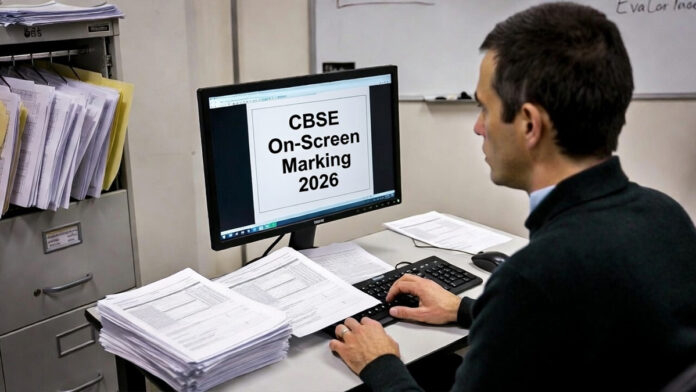
The Central Board of Secondary Education (CBSE) is set to introduce a major reform in its evaluation system. Starting 2026, the board will assess Class 12 board examination answer sheets through an On-Screen Marking (OSM) system, marking a shift toward fully digital evaluation.
However, CBSE has clarified that Class 10 answer sheets will continue to be evaluated through the traditional physical method for now.
CBSE Board Exams Conducted at Massive Scale
CBSE conducts Class 10 and Class 12 board examinations across India and 26 other countries, with participation from nearly 4.6 million students every year. To manage evaluation at this scale more efficiently, the board is moving toward technology-driven solutions.
The on-screen marking system is intended to make evaluation faster, more transparent, and less prone to human error.
CBSE Board Exam Dates 2026
According to the official CBSE date sheet:
Board exams begin: February 17, 2026
Class 10 exams end: March 11, 2026
Class 12 exams conclude: April 10, 2026
From this examination cycle onward, Class 12 answer sheets will be evaluated digitally, making 2026 the first year of full-scale implementation.
What Is the On-Screen Marking (OSM) System?
On-screen marking is a digital evaluation process in which students’ answer sheets are scanned and uploaded to a secure online platform. Teachers then log in to the system using computers or laptops and evaluate answers directly on screen.
CBSE stated in a circular issued on February 9 that this system will significantly reduce delays and common errors associated with manual checking.
Key Benefits of On-Screen Marking
According to CBSE, the new system offers several advantages:
Eliminates errors in totaling and transferring marks
Reduces the need for physical transportation of answer sheets
Allows teachers to evaluate copies from their own schools, avoiding travel to evaluation centers
Speeds up the overall marking and result preparation process
Enables participation of more evaluators simultaneously
Minimizes the need for post-result verification of marks
Reduces dependence on additional staff after results
Saves time and administrative costs
Allows CBSE-affiliated schools abroad to easily join the evaluation process
Environment-friendly due to reduced paper use and logistics
Digital Evaluation and Transparency
With the shift to digital marking, CBSE aims to ensure greater accuracy, accountability, and consistency in evaluation. Each step of the process is monitored electronically, reducing the scope for discrepancies.
The board believes that this move will help deliver results faster and with fewer disputes, benefiting students, teachers, and administrators alike.
What Students and Teachers Should Know
While the change does not directly affect how students write their exams, experts suggest that clear handwriting, proper spacing, and structured answers will remain crucial, as scanned copies are evaluated on screen.
Teachers will receive special training and technical support to adapt smoothly to the digital system.