NEW DELHI, India — June 17, 2026
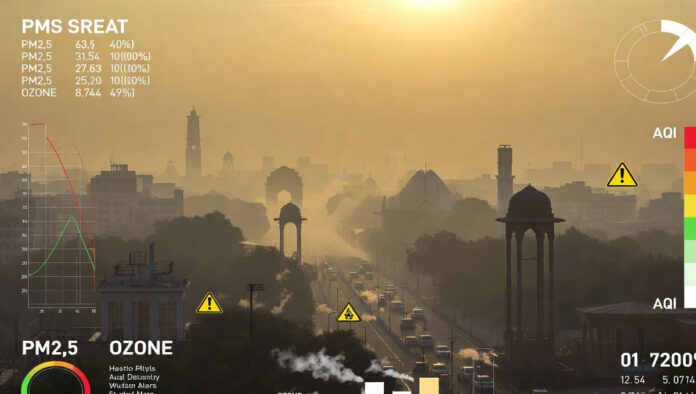
Delhi Ozone Pollution is becoming an increasingly serious environmental and public health concern, with a new analysis showing that nearly half of the capital’s air quality monitoring stations recorded ozone levels above national safety standards during May.
While discussions around Delhi’s air quality have traditionally focused on particulate matter such as PM2.5 and PM10, experts now warn that ground-level ozone is rapidly emerging as another major pollutant affecting millions of residents across the city.
According to a recent assessment by the Centre for Research on Energy and Clean Air (CREA), 24 of Delhi’s 45 air quality monitoring stations reported ozone concentrations exceeding India’s National Ambient Air Quality Standards during May. The findings suggest that ozone pollution is no longer confined to industrial zones or traffic-heavy corridors but is increasingly affecting residential, educational and institutional areas across the city.
Pusa Records Highest Ozone Levels in Delhi
The CREA analysis identified five major ozone hotspots in Delhi, with the highest concentration recorded at the Indian Institute of Tropical Meteorology (IITM) monitoring station in Pusa.
The station registered an eight-hour average ozone concentration of 292 micrograms per cubic meter, nearly three times higher than the national standard of 100 micrograms per cubic meter.
Other major hotspots included:
| Location | Ozone Level (µg/m³) |
|---|---|
| Pusa (IITM) | 292 |
| NSUT Jaffarpur | 229 |
| Commonwealth Sports Complex | 208 |
| Delhi University North Campus | 207 |
| Chandni Chowk | 178 |
These figures indicate that ozone pollution is affecting a broad range of urban environments, including educational institutions, residential neighborhoods and commercial districts.
Ozone Pollution Persisted for Weeks
Among all monitoring locations, the Pusa station recorded the most prolonged ozone pollution episode, with ozone concentrations remaining above prescribed limits for 25 days during May.
Several other monitoring sites also reported repeated exceedances, highlighting the widespread nature of the problem. Environmental experts note that the distribution of affected stations across diverse parts of the city demonstrates that ozone pollution is no longer a localized issue.
Ozone No Longer Just a Summer Problem
According to CREA India analyst Manoj Kumar, factors such as wind direction, temperature, sunlight intensity and atmospheric chemical reactions determine how ozone accumulates in a particular area.
The analysis also suggests that ozone pollution in Delhi is extending beyond the traditional summer season.
This year, ozone emerged as the dominant pollutant in Delhi’s Air Quality Index (AQI) on:
- 2 days in January
- 16 days in February
- 8 days in March
The trend marks a significant increase compared with previous years. In February 2025, ozone was the primary pollutant for nine days, while no such instances were recorded during February 2023.
Experts believe changing climate patterns, rising emissions and prolonged exposure to intense sunlight are contributing to the increasing frequency of ozone pollution episodes.
How Ground-Level Ozone Forms
Unlike pollutants directly emitted from vehicles, factories or construction activities, ground-level ozone is not released into the atmosphere from a single source.
Instead, it forms through complex chemical reactions involving:
- Nitrogen Oxides (NOx)
- Volatile Organic Compounds (VOCs)
- Strong sunlight and high temperatures
When these pollutants interact under sunny conditions, ozone is created near the Earth’s surface. Because it is formed through atmospheric reactions rather than direct emissions, controlling ozone pollution is significantly more challenging than managing conventional pollutants.
Health and Environmental Concerns
Ground-level ozone is widely recognized as a harmful pollutant that can affect respiratory health, particularly among children, older adults and individuals with asthma or other lung conditions.
Long-term exposure may contribute to breathing difficulties, reduced lung function, throat irritation and increased vulnerability to respiratory illnesses.
Environmental experts say the growing ozone burden underscores the need for more comprehensive air pollution control strategies that target precursor emissions from transportation, industrial activity and other urban sources.
As Delhi continues to battle multiple forms of air pollution, the latest findings highlight the urgent need for policymakers and environmental agencies to address ozone as a major component of the city’s air quality challenge.