Washington, D.C., Feb. 22, 2026
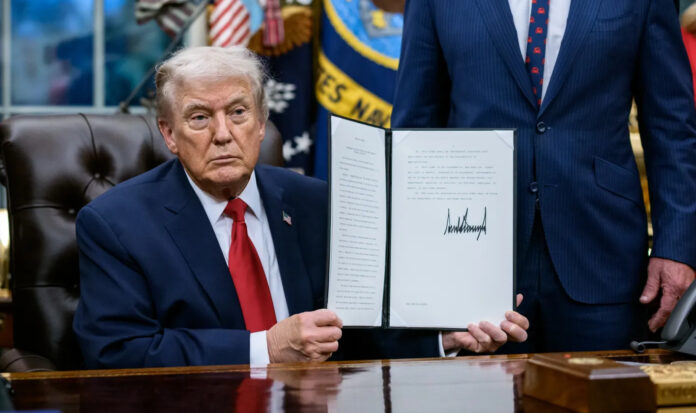
U.S. President Donald Trump announced that his administration will raise tariffs on imports from around the world from 10% to 15%, intensifying global trade tensions just hours after a major court setback.
In a social media statement, Trump criticized a recent ruling by the U.S. Supreme Court, calling it “badly written” and contrary to American interests. He said the tariff hike would take effect immediately and argued that the move was necessary because “many countries have taken advantage of the United States for decades.”
Court Blocks Earlier Tariff Order
On Friday, the Supreme Court ruled 6–3 against a prior sweeping tariff measure imposed by the administration. The justices concluded that the White House had exceeded its authority by using emergency powers under the International Emergency Economic Powers Act (IEEPA) of 1977 to justify broad trade tariffs.
The court stated that the law was designed for genuine national emergencies, not for routine trade policy or revenue-raising measures, emphasizing that presidential emergency powers have defined limits.
New Strategy Using Trade Law
Within hours of the ruling, Trump announced a revised policy using Section 122 of the Trade Act of 1974, which allows temporary tariffs of up to 15% for as long as 150 days to address balance-of-payments concerns.
Initially set at 10% under this authority, the administration has now increased the rate to the legal maximum of 15%, saying the measure is “fully lawful and tested.”
At a press briefing, Trump insisted the court decision did not weaken his authority. Instead, he argued it clarified the legal boundaries and opened alternative routes for imposing tariffs.
Political Message and Economic Goals
The president framed the decision as part of his economic agenda, saying higher tariffs would:
Strengthen domestic manufacturing
Reduce reliance on foreign imports
Increase federal revenue
Bolster economic security
He added that additional trade measures could be introduced in coming months using what he described as “legally sound” methods.
Global Impact and Reaction Outlook
Trade analysts warn the move could inject new uncertainty into international markets. Higher U.S. import duties may affect export-dependent economies and could trigger retaliatory tariffs from trading partners.
Policy experts say attention will now shift to:
Possible congressional response
International diplomatic reactions
Potential legal challenges
For now, the administration appears determined to continue pursuing aggressive tariff policies despite judicial resistance.