BERLIN/PARIS – January 5, 2026
Political upheaval grips Europe’s powerhouses, Germany and France, as the far-right’s ascendance in early 2026 tests the European Union’s foundational stability. With polls showing unprecedented gains for extremist parties, longstanding coalitions are fraying, migration policies are under fire, and public discontent over economic stagnation boils over into street protests.
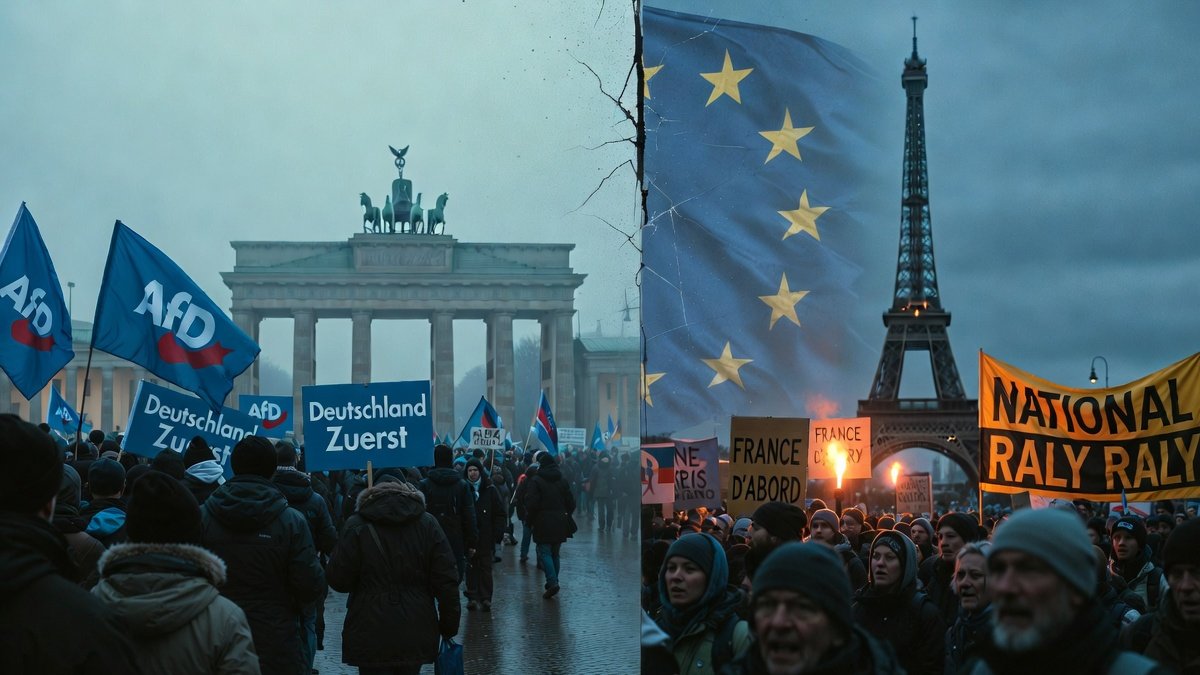
In Germany, Chancellor Olaf Scholz confronts an existential challenge to his leadership. The Alternative for Germany (AfD), the country’s far-right party, has surged to become the second-largest political force, according to January 2026 surveys reported by Deutsche Welle. This rise coincides with deepening rifts in Scholz’s “traffic light” coalition—comprising the Social Democrats (SPD), Greens, and Free Democrats (FDP)—over budget allocations and energy strategies. Whispers in political circles suggest snap elections could materialize later this year, though no official announcements have been made. Compounding these tensions, Germany’s economic slowdown has bred widespread voter frustration, channeling support toward far-right platforms that promise stricter border controls and national prioritization.
Across the Rhine in France, President Emmanuel Macron grapples with intensifying pressure from Marine Le Pen’s National Rally (RN). Lacking a parliamentary majority, Macron’s administration has repeatedly resorted to Article 49.3 of the constitution to bypass legislative gridlock and enact reforms, as highlighted by France 24 coverage. Fresh demonstrations erupted in major cities this January against proposed pension and labor overhauls, drawing backing from both far-right and left-wing factions. These protests underscore a broader polarization, with RN leveraging anti-immigration sentiment to erode Macron’s approval ratings.
At the heart of the discord lies the European Union’s contentious migration policy. A recently adopted EU pact aimed at redistributing refugees across member states has met fierce resistance from far-right groups in both nations. In Germany, regional calls for enhanced border measures echo sentiments in Hungary and Poland, where “open border” opposition runs high. The rallying cry of “Europe First,” popularized by these parties, increasingly permeates mainstream discourse, per Euronews analysis. This stance also diverges sharply from official EU lines on military aid to Ukraine and sanctions against Russia, raising alarms about bloc cohesion.
Experts warn that sustained far-right momentum could evoke Brexit-era fractures within the EU. Should Germany face governmental collapse or France undergo a major cabinet overhaul—rumors of which swirled through European corridors in late 2025—the ripple effects could destabilize continental alliances. For now, leaders in Berlin and Paris navigate these treacherous waters, balancing domestic imperatives with the imperatives of European solidarity.