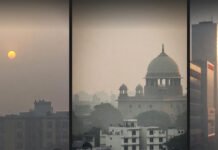
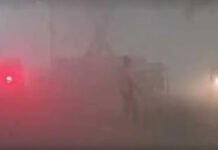
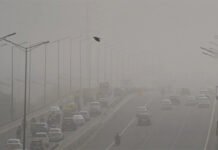
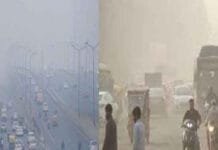
Delhi’s air quality deteriorated sharply on Friday, with the Air Quality Index (AQI) climbing to 335, placing the city firmly in the ‘very poor’ category. A thick blanket of winter smog covered major parts of the capital, reducing visibility and prompting urgent control measures by civic authorities.
According to the Central Pollution Control Board (CPCB), the city’s pollution surge was driven by vehicular emissions, construction dust, and stubble burning in nearby states, compounded by cold air and stagnant wind that trapped pollutants near the surface.
“Low wind speeds and falling night temperatures have slowed the dispersion of pollutants, leading to a sustained smog layer,” said a senior official from the India Meteorological Department (IMD).
Emergency Measures Rolled Out
In response, the Delhi government and municipal corporations have begun mechanical road sprinkling, anti-dust operations, and intensified traffic checks to curb emissions. Authorities also advised residents to avoid outdoor exercise and keep windows closed during peak pollution hours.
The Graded Response Action Plan (GRAP) Stage II remains in force, restricting the use of diesel generators and urging industries to switch to cleaner fuels.
“We’re implementing emergency actions to reduce surface-level dust and vehicular pollution,” a Delhi Pollution Control Committee (DPCC) spokesperson said.
Forecast: No Immediate Relief
Despite active interventions, experts predict no significant improvement in the coming days. IMD models suggest that air stagnation and falling temperatures will continue to worsen conditions through the weekend.
“AQI may touch the ‘severe’ range if winds don’t pick up,” warned Dr. Gufran Beig, founder of the System of Air Quality and Weather Forecasting and Research (SAFAR).
Satellite data also shows increasing stubble fire activity in Punjab and Haryana, contributing to the haze drifting into Delhi’s airspace.
Public Health Impact
Health experts have urged citizens, especially children and the elderly, to limit outdoor exposure and use N95 masks when stepping out. Hospitals across the NCR reported a rise in respiratory and eye irritation cases over the past 48 hours.
“Even short-term exposure at this level can trigger asthma, coughing, and cardiac strain,” said Dr. R.K. Suri, pulmonologist at AIIMS.