
WASHINGTON, D.C. | June 30, 2026
Ro Khanna Says India-US Partnership Should Be Guided by Democratic Values, Not Just Strategic Interests
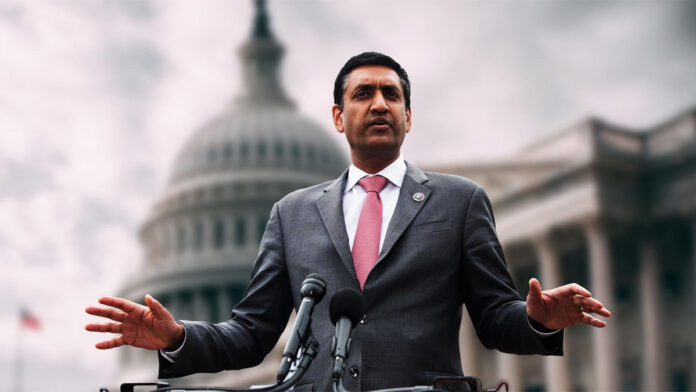
Ro Khanna India-US Partnership was the central theme of remarks delivered by Democratic Congressman Ro Khanna at the US-India Strategic Partnership Forum (USISPF) Leadership Summit, where he argued that the long-term relationship between the United States and India should be grounded in shared democratic values rather than purely transactional interests.
Representing California’s Silicon Valley and widely regarded as one of the Democratic Party’s leading voices on technology and foreign policy, Khanna also sharply criticized President Donald Trump’s foreign and immigration policies. He contended that America’s global leadership depends not only on economic and military strength but also on its commitment to democracy, human rights, and openness.
Khanna Criticizes Trump’s Foreign Policy Approach
During his address, Khanna argued that the Trump administration’s approach to foreign policy and international trade had weakened America’s standing with allies.
He criticized what he described as unilateral actions and tariff-driven policies, saying the United States must work to rebuild trust and credibility with partners around the world.
According to Khanna, future American leaders will need to restore confidence in US leadership by strengthening alliances and reaffirming long-standing international commitments.
India-US Partnership Should Go Beyond Trade and Defense
While discussing bilateral relations, Khanna emphasized that cooperation between India and the United States should extend beyond defense agreements, trade negotiations, and investment opportunities.
Speaking as an Indian American, he said he hopes both countries will increasingly define their partnership through shared democratic ideals, respect for individual liberty, and support for human dignity.
According to Khanna, the relationship should reflect common values that promote freedom and democratic governance both domestically and internationally.
He argued that a durable strategic partnership requires a foundation rooted in principles as well as mutual interests.
Shared Values Should Shape Global Cooperation
Khanna said the United States and India should work together to advance self-determination, peaceful cooperation, and solutions to global challenges affecting humanity.
Rather than supporting alliances based solely on geopolitical calculations, he advocated partnerships built around countries committed to advancing democratic governance, pluralism, and human rights.
He suggested that such an approach would strengthen international cooperation while reinforcing the broader strategic relationship between New Delhi and Washington.
References to America’s Democratic Traditions
Framing his remarks within America’s historical commitment to democracy and decolonization, Khanna contrasted the foreign policy of former President Franklin D. Roosevelt with what he characterized as President Trump’s more transactional approach.
He described the United States as a nation historically associated with freedom, human rights, and support for democratic values around the world.
According to Khanna, those ideals have inspired generations of immigrants—including his own family—to build their lives in America.
He said the country’s identity has long been shaped by its commitment to liberty and equal opportunity.
Immigration Policy and Global Talent
Khanna also criticized the administration’s immigration policies, arguing they could undermine America’s ability to attract highly skilled professionals at a time of intense global competition in emerging technologies.
He pointed to the increasingly international nature of artificial intelligence research, noting that many leading AI researchers were born outside the United States or received foreign university degrees.
According to Khanna, maintaining American leadership in AI, semiconductor research, advanced computing, and innovation requires policies that continue attracting talented individuals from around the world.
He argued that strengthening the nation’s talent pipeline is essential to maintaining technological competitiveness.
Optimistic Outlook for Democratic Party
Looking ahead to upcoming US elections, Khanna expressed confidence about the Democratic Party’s political prospects.
He predicted Democratic victories in the 2026 congressional elections and the 2028 presidential election, arguing that the United States has repeatedly demonstrated its capacity for political renewal following periods of national division.
Khanna said America’s democratic institutions have historically shown resilience and an ability to adapt to changing political and economic circumstances.
America’s Strength Lies in Renewal
The congressman argued that one of the defining characteristics of the United States is its ability to reform itself.
He described the country as striving to become an increasingly inclusive, multiracial democracy built on equal rights and civic participation.
According to Khanna, that process of continuous improvement remains central to America’s democratic identity.
India-US Trade Deal Enters Final Stage as US Envoy Says Agreement Is in the ‘Last 1-2%’
Personal Story Reflects Shared Democratic Ideals
Khanna also spoke about his personal background as an Indian American and practicing Hindu.
He said he draws inspiration from his grandfather, who participated in India’s independence movement, as well as from generations of Americans who fought to strengthen democracy and expand civil rights.
Reflecting on both traditions, Khanna said he hopes the India-US partnership continues advancing freedom, human dignity, and democratic governance.
Longtime Advocate for India-US Technology Cooperation
Since first being elected to Congress in 2017, Khanna has represented California’s 17th Congressional District, which includes much of Silicon Valley and is home to many of the world’s leading technology companies.
Throughout his tenure, he has consistently supported closer cooperation between India and the United States in areas including:
- Artificial intelligence
- Semiconductor manufacturing
- Advanced technology
- Innovation and research
- Digital infrastructure
- Clean energy
- Strategic investment
At the same time, he has remained an outspoken critic of several policies pursued by the Trump administration.
India-US Strategic Partnership Continues to Expand
Khanna’s remarks come as India and the United States continue broadening cooperation across defense, trade, semiconductor manufacturing, artificial intelligence, critical technologies, and supply chain resilience.
Despite differing political perspectives within Washington, bipartisan support for closer engagement with India remains strong, particularly in areas involving technology, economic security, and Indo-Pacific stability.
His speech underscored the view that while economic and strategic cooperation will remain essential, shared democratic principles could play an equally important role in shaping the long-term direction of the bilateral relationship.





[…] Ro Khanna Criticizes Trump’s Foreign and Immigration Policies, Calls for India-US Partnership Buil… […]
Comments are closed.