WASHINGTON/GENEVA — June 18, 2026
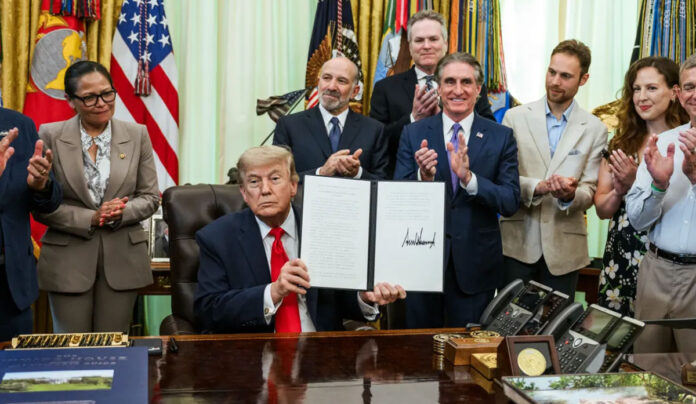
US-Iran Peace Agreement efforts moved forward significantly after US President Donald Trump reportedly approved and signed a draft framework aimed at reducing tensions between Washington and Tehran, according to officials familiar with the negotiations.
The proposed agreement, which has emerged as a major diplomatic initiative in the Middle East, includes commitments related to military de-escalation, maritime security, sanctions relief, economic reconstruction, and oversight of Iran’s nuclear activities. Officials from both countries have indicated their willingness to continue discussions toward a comprehensive and legally binding settlement.
According to reports citing US officials, President Trump formally signed the draft memorandum during a diplomatic gathering on Wednesday evening. The development marks one of the most significant diplomatic engagements between the United States and Iran in recent years and could potentially reshape security dynamics across the Middle East.
Iranian officials have also acknowledged progress in negotiations. Iranian Foreign Ministry spokesperson Esmail Baghaei stated that the peace framework had reached a critical stage following approval by both sides and emphasized that the focus would now shift toward implementation and compliance.
While formal signing ceremonies were previously expected to take place in Switzerland, officials indicated that scheduled diplomatic meetings in Geneva will proceed as planned to finalize technical details and implementation mechanisms.
Draft Agreement Reveals Broad Framework for De-Escalation
The proposed memorandum outlines a series of commitments intended to reduce the risk of military confrontation and establish a pathway toward long-term regional stability.
Among the most significant provisions is a commitment by both countries and their respective partners to halt military operations across multiple fronts, including areas affected by broader regional conflicts. The framework also calls for mutual respect for sovereignty, territorial integrity, and non-interference in internal affairs.
Negotiators have reportedly agreed to pursue a final comprehensive agreement within 60 days, although that timeline could be extended by mutual consent if additional discussions are required.
Maritime Security and Strait of Hormuz Provisions
One of the most closely watched sections of the draft concerns maritime security.
The agreement proposes steps to restore normal shipping activity in strategic waterways connecting the Persian Gulf and the Gulf of Oman. Iran would facilitate safe commercial navigation and support efforts to remove technical and military obstacles affecting maritime trade routes.
The framework also calls for future discussions involving regional coastal states regarding the long-term administration and management of maritime services connected to the Strait of Hormuz, one of the world’s most critical energy transit corridors.
Sanctions Relief and Economic Reconstruction
Economic measures form a central component of the proposed agreement.
Under the draft framework, the United States would begin procedures aimed at removing maritime restrictions and other barriers affecting Iranian trade. The proposal also includes commitments to facilitate financial transactions and commercial activities through licenses, waivers, and regulatory permissions.
A major reconstruction initiative valued at approximately $300 billion is also envisioned. The plan would involve cooperation between the United States and regional partners to support Iran’s economic development and post-conflict rebuilding efforts.
In addition, the agreement discusses the gradual removal of sanctions imposed through US measures, international resolutions, and related restrictions, subject to the successful implementation of agreed provisions.
Nuclear Commitments Remain a Key Element
The nuclear issue remains at the center of negotiations.
According to the draft, Iran would reaffirm its commitment not to pursue or develop nuclear weapons. The document also includes provisions for international monitoring and oversight through the International Atomic Energy Agency (IAEA).
Until a final agreement is reached, Iran would maintain the current status of its nuclear program, while the United States would refrain from imposing new sanctions or expanding military deployments connected to the dispute.
Monitoring and Enforcement Mechanism Planned
To ensure compliance, both countries intend to establish a joint implementation and monitoring mechanism. The body would oversee fulfillment of obligations and provide a structured process for addressing disputes or concerns arising during implementation.
The draft further proposes that any final agreement receive support through a binding resolution of the United Nations Security Council, providing an international legal framework for enforcement and long-term stability.
Regional and Global Implications
If finalized, the US-Iran Peace Agreement could represent one of the most consequential diplomatic breakthroughs in the Middle East in recent years. The proposed framework seeks to address military tensions, restore economic engagement, secure critical maritime routes, and establish safeguards around Iran’s nuclear activities.
However, diplomats caution that substantial negotiations remain before a final agreement is concluded. Implementation, verification, and political approval processes will likely determine whether the framework evolves into a lasting settlement capable of reducing long-standing tensions between the two countries and contributing to broader regional stability.