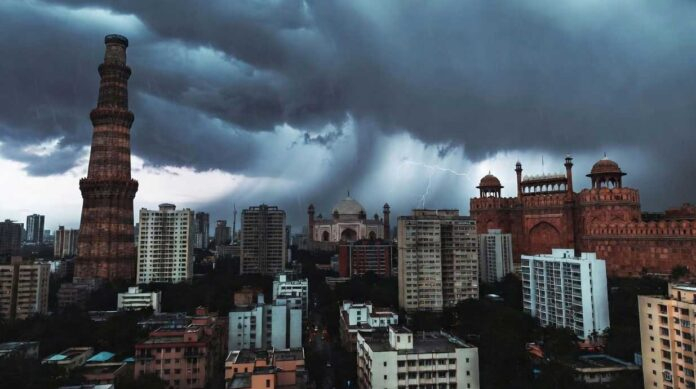
NEW DELHI, India — May 11, 2026
A fresh western disturbance became active over northwest India early Sunday, triggering a major shift in weather conditions across the Himalayan region and adjoining plains, according to the India Meteorological Department (IMD).
The weather system is expected to bring widespread rain, thunderstorms, lightning, gusty winds and isolated hailstorms to several northern states beginning Monday, while parts of Rajasthan and Gujarat continue to battle intense heatwave conditions.
The IMD said weather activity will intensify across Jammu and Kashmir, Ladakh, Himachal Pradesh and Uttarakhand between May 11 and May 14, with light to moderate rainfall likely in many districts. Strong winds and thunderstorms are also expected during the same period.
Delhi-NCR Likely to Receive Light Rain and Gusty Winds
The national capital region may witness cloudy skies, lightning and light rain through May 12, offering temporary relief from rising temperatures.
Several parts of Punjab, Haryana, Chandigarh and Uttar Pradesh are also expected to receive scattered rainfall accompanied by thunderstorms and gusty winds over the next few days.
The IMD has additionally warned of possible hailstorms in Himachal Pradesh and Uttarakhand on May 12 and 13, while Jammu and Kashmir could experience hail activity on May 11 and 12.
Heatwave Alert Continues in Rajasthan and Gujarat
Even as rain impacts northern states, heatwave conditions are likely to persist across western India.
According to the IMD, eastern and western Rajasthan along with Gujarat may continue to experience severe heat until May 15. Day temperatures remain above 104°F (40°C) in several parts of Rajasthan, Gujarat, Madhya Pradesh, Vidarbha, Marathwada, Telangana and Rayalaseema.
Weather officials said maximum temperatures across northwest India could rise by 3°C to 5°C by May 15, while central India may see temperatures climb by 2°C to 4°C.
Low Pressure Area May Impact Eastern and Southern India
Meteorologists are also monitoring a potential low-pressure area forming over the southwest Bay of Bengal around May 11. The developing system could influence weather conditions across eastern and southern India later this week.
The IMD has forecast thunderstorms, lightning and strong winds reaching speeds of 25 to 37 mph (40 to 60 kmph) across Tamil Nadu, Puducherry, Karaikal, Kerala and Mahe over the next seven days.
Heavy rainfall activity is expected to intensify in Tamil Nadu and Kerala on May 14 and 15. Coastal Andhra Pradesh, Rayalaseema, Telangana and parts of Karnataka may also witness thunderstorms and moderate rainfall during the period.
Lakshadweep has been placed under a heavy rainfall alert as moisture-laden winds strengthen over the Arabian Sea.
Northeast India Braces for Heavy Rainfall
Rainfall activity is also expected to continue across northeastern states including Assam, Meghalaya, Arunachal Pradesh, Nagaland, Manipur, Mizoram and Tripura between May 11 and May 15.
The IMD warned that Assam and Meghalaya could receive very heavy rainfall on May 14 and 15.
Meanwhile, Bihar, Jharkhand, Odisha, West Bengal and Sikkim are likely to witness thunderstorms, lightning and isolated hailstorms. Wind speeds in parts of Bihar, Jharkhand and Gangetic West Bengal may reach up to 43 mph (70 kmph), raising concerns over localized damage and disruptions.
Severe Weather Reported Across India on Sunday
Several states witnessed turbulent weather conditions over the weekend.
From Uttarakhand to Odisha and from Bihar to Kerala and Tamil Nadu, heavy rainfall and strong winds impacted normal life in multiple regions on Sunday.
The IMD said very heavy rainfall ranging between 7 cm and 20 cm was recorded in parts of Tamil Nadu and Kerala during the previous 24 hours ending Sunday morning.
Thunderstorms with wind speeds between 31 mph and 59 mph (50 to 95 kmph) were reported across Bihar, Jharkhand, Odisha, Gangetic West Bengal, Madhya Pradesh, Konkan and Goa, central Maharashtra, Marathwada and Tamil Nadu.
Hailstorms were also reported in parts of western Madhya Pradesh, Vidarbha, Chhattisgarh and Jharkhand, while Jammu and Kashmir continued to experience unusually hot conditions resembling severe heatwave patterns.