San Francisco, California — March 9, 2026
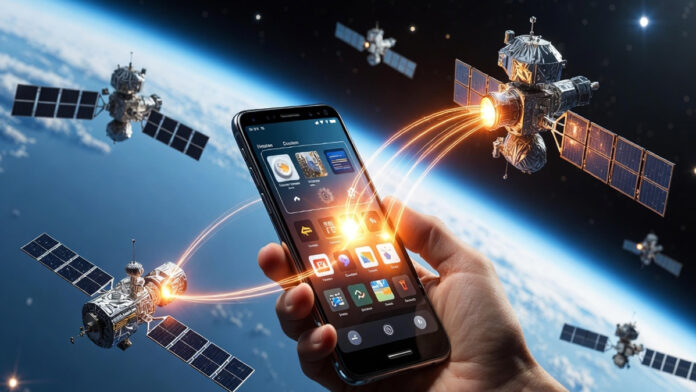
A new generation of smartphones is being developed that could operate without a physical SIM card or even an eSIM, connecting directly to satellites for communication.
The emerging technology—often referred to as Direct-to-Cell satellite connectivity—is expected to reshape how mobile networks operate, especially in regions where traditional cellular towers are unavailable.
Industry experts say the innovation could mark one of the most significant shifts in mobile communication technology in decades.
How SIM-Less Satellite Phones Could Work
Unlike traditional satellite phones that require large external antennas, the new concept integrates specialized modems directly inside smartphones.
These modems would connect to satellites orbiting in Low Earth Orbit.
Because these satellites operate closer to Earth, they can provide direct communication signals to standard smartphones without requiring bulky satellite equipment.
Freedom From SIM and eSIM
Today’s smartphones rely on either a physical SIM card or eSIM profiles managed by telecom operators.
However, next-generation devices could bypass traditional telecom networks entirely by connecting directly to satellite networks.
For example, users could potentially send messages or make calls through satellite systems operated by companies such as SpaceX or Apple.
This approach would eliminate the need for conventional mobile carriers in certain situations.
Companies Competing in Satellite Phone Technology
Several major technology companies are actively working on satellite connectivity for smartphones.
SpaceX and T-Mobile
SpaceX has already launched satellites capable of delivering Direct-to-Cell signals, working in partnership with T‑Mobile.
These satellites are designed to provide satellite coverage to ordinary smartphones without requiring hardware modifications.
Apple’s Expanding Satellite Features
Apple introduced satellite emergency messaging with the iPhone 14.
Industry reports suggest Apple may expand this capability in future iPhone models to support full satellite calling and messaging services.
Google and Android Satellite Support
Google is also integrating satellite communication features into the Android ecosystem.
Upcoming versions of the operating system, including Android 15 and future releases, are expected to include native satellite connectivity support.
Biggest Advantage: Connectivity Anywhere
One of the most significant benefits of SIM-less satellite smartphones is global connectivity in remote locations.
Such technology could enable communication in areas where cellular networks are unavailable, including:
Remote mountain regions
Deep forests
Open ocean areas
Disaster-affected zones with damaged infrastructure
For emergency responders and travelers, this capability could significantly improve safety and communication reliability.
Key Challenge: Limited Speeds
Despite its promise, the technology still faces technical limitations.
Early versions of satellite-based mobile connectivity are expected to offer speeds of around 2–4 Mbps, significantly slower than modern 4G or 5G networks.
Because of this, the initial services may focus primarily on text messaging and emergency calls, with broader data services gradually expanding over time.
A New Era for Mobile Connectivity
As satellite networks continue to grow and smartphone manufacturers integrate new hardware capabilities, SIM-less mobile communication could become a major trend in the next generation of smartphones.
Industry analysts say that if these technologies mature successfully, they could transform how billions of people stay connected worldwide.