Mumbai, India | February 1, 2026
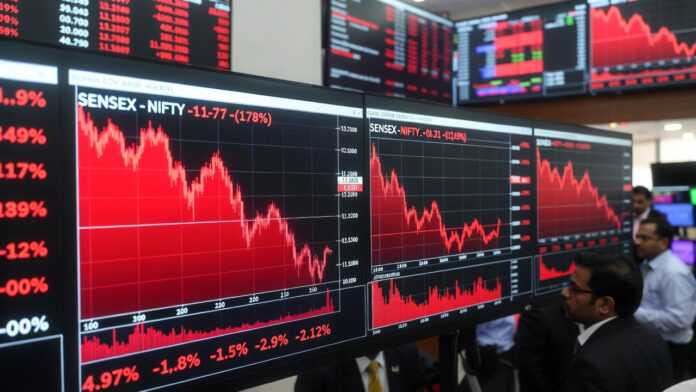
Indian equity markets reacted sharply to the Union Budget 2026, witnessing a steep sell-off during the special Sunday trading session. Benchmark indices plunged as investors digested multiple tax-related announcements affecting buybacks and derivatives trading.
The BSE Sensex crashed more than 2,300 points, while the Nifty 50 fell over 600 points, reflecting widespread risk aversion.
📉 Markets Sink After Budget Announcements
Soon after the budget presentation, selling pressure intensified across sectors. The Sensex slipped sharply, while the Nifty dropped to 24,592.15, marking one of the biggest single-session declines in recent months.
Investors reacted negatively to proposals involving higher taxation on share buybacks and an increase in securities transaction tax (STT) on futures.
🧾 Key Budget Announcements That Spooked Markets
The finance minister outlined several measures aimed at curbing misuse in capital markets, but traders viewed them as sentiment dampeners:
Buyback Tax Changes:
All shareholders to be taxed on buybacks as capital gains
22% tax on corporate promoters
30% tax on non-corporate promoters
STT Hike on Futures:
Securities Transaction Tax on futures increased to 0.05%
Market participants said these measures could reduce liquidity and discourage trading activity in the short term.
📊 Volatile Session: Early Fall, Brief Recovery
The special trading session saw sharp volatility. In early trade:
Sensex slipped 15.04 points (0.02%) to 82,254.74
Nifty fell 31.75 points (0.13%) to 25,288.90
Later, a brief recovery was seen. By 10:39 a.m., the Sensex had risen 255.96 points to 82,525.74, while the Nifty gained 56.60 points to 25,377.25. However, the rebound was short-lived as heavy selling resumed post-budget.
🏛️ Why Markets Were Open on a Sunday
Due to the Union Budget being presented on a Sunday, both the National Stock Exchange of India and the Bombay Stock Exchange conducted a special live trading session on February 1.
The exchanges stated that keeping markets open allows investors to respond immediately to major fiscal and policy announcements rather than waiting until Monday.
Historically, Indian stock markets have opened on a Sunday only once before—on February 28, 1999, during the tenure of former Prime Minister Atal Bihari Vajpayee.
📌 Why Sunday Trading Was Considered Necessary
Market experts cited three main reasons for Sunday trading on Budget Day:
Immediate Decision-Making: Investors can react instantly to policy changes
Risk Management: Avoids uncertainty and gap risk if markets remained closed
Transparency: Reduces chances of off-market speculation during holidays
🔍 Market Outlook
Analysts say markets may remain volatile in the near term as participants reassess the impact of higher transaction costs and taxation on corporate actions. Long-term direction will depend on earnings growth, global cues, and policy follow-through.