
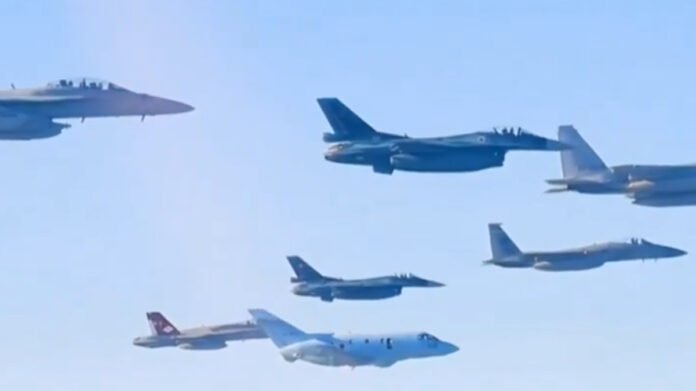
Tokyo, : Tensions surged across East Asia as the United States and Japan carried out joint military drills featuring U.S. nuclear-capable B-52 bombers and Japanese F-15 fighters over the Sea of Japan. The coordinated operation came just days after China and Russia conducted large-scale joint exercises, sending more than 20 warplanes into Japan’s Air Defense Identification Zone (ADIZ) in one of the most aggressive incursions in recent years.
Japan condemned the breach as a “provocative act” that threatened regional stability. Defense Minister Gen Nakatani oversaw Tokyo’s response, while Admiral Samuel Paparo, head of U.S. Indo-Pacific Command, reaffirmed Washington’s “unwavering commitment” to defend Japan under the U.S.–Japan Security Treaty.
A Dangerous Escalation in the Indo-Pacific
Security analysts warn that the rising tempo of military maneuvers could spiral into a broader confrontation. China’s rapid naval expansion in the South China Sea, paired with Russia’s increasing military cooperation, has alarmed policymakers in Tokyo, Seoul, and Washington.
The drills also follow a recent controversy in which a Chinese naval vessel allegedly locked its radar on a Japanese destroyer, prompting U.S. officials to criticize Beijing’s actions as “unsafe and unprofessional.”
Economic and Strategic Stakes
The intensifying standoff comes as the Indo-Pacific remains a vital artery for global trade flows. Any military miscalculation, analysts say, could disrupt supply chains and maritime routes critical to the world economy.
Japan has already committed to raising its defense budget to 2% of GDP by 2027, echoing NATO-level spending as concerns grow about the shifting balance of power in the region. Beijing, however, accused Washington of “stoking tensions for hegemony,” arguing that U.S. military presence destabilizes rather than secures the region.
A Region on Edge
The latest developments highlight the fragile security landscape in the Indo-Pacific, where alliances are being tested daily amid intensifying U.S.–China rivalry. With each side expanding military operations and strengthening regional partnerships, diplomats warn that the margin for error is narrowing rapidly.