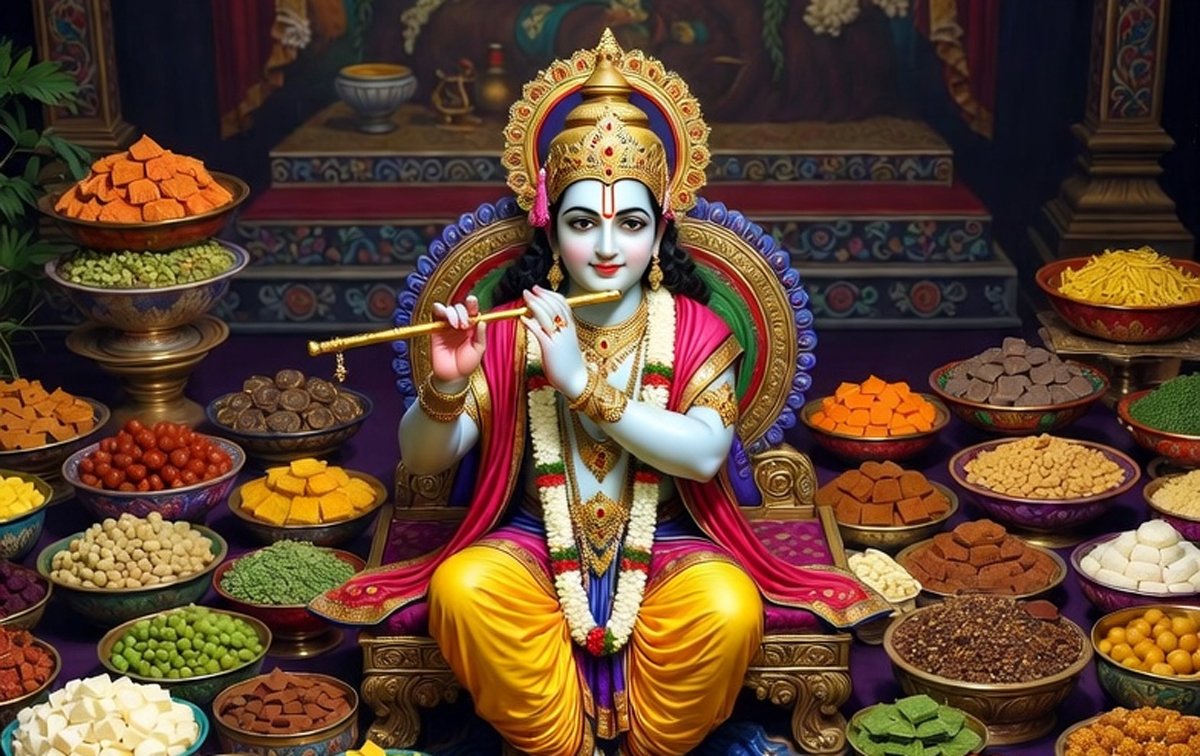
Mathura, December 6, 2025 — In India, worship is more than a ritual—it’s an emotion, a relationship, and a warm, homely atmosphere where devotees treat God not as a distant deity but as a beloved member of the family. One of the most heartfelt expressions of this devotion is the offering of bhog, where devotees present food to God with love and gratitude. Among all offerings in Hindu tradition, the most celebrated is Chappan Bhog—the revered platter of 56 dishes offered especially to Lord Krishna.

Many wonder: Why exactly 56? Why not 60 or 100? According to astrologer Pandit Ajay Kaushik, the answer lies in a deeply symbolic and emotional episode from Krishna’s life—one that showcases love, sacrifice, and devotion at its purest.
1. The Tradition of Offering Bhog
In Indian households, offering bhog is considered a daily act of gratitude. From simple home-cooked meals to sweets and fruits, devotees offer food to God during morning and evening prayers. For many, bhog is not just food—it is an expression of affection, respect, and emotional connection.
On auspicious days and major festivals, special dishes are prepared with great devotion. This loving tradition forms the foundation of the famous 56 Bhog offering.
2. Why Are 56 Dishes Offered to God—Not 60 or 100?
The number 56 symbolizes the 56 unique dishes that are traditionally offered to Lord Krishna. But the significance goes deeper than culinary variety. It stems from a legendary moment where Krishna went without food for seven days to protect the people of Gokul.
This divine sacrifice inspired villagers to create a tradition that honored Krishna’s love and endurance—thus giving birth to Chappan Bhog.
3. The Story of Indra and Govardhan
According to the Bhagavat Purana, the people of Gokul worshipped Lord Indra each year to ensure good rainfall and successful harvests. Young Krishna, however, explained to them that it was actually Govardhan Hill that sustained their cattle, crops, and water sources.
Convinced by Krishna’s wisdom, the villagers stopped Indra’s worship and instead honored Govardhan. Angered, Indra unleashed relentless rainstorms on Gokul—pouring down for seven days and seven nights.
To protect everyone, Krishna lifted Govardhan Hill on his little finger, giving shelter to all. During this time, he did not eat even once.
Seeing this sacrifice, the villagers felt deep gratitude. After the danger passed, they decided to honor Krishna’s seven days of fasting by offering him eight times his usual daily meal.
4. How the Number 56 Was Calculated
Krishna ate one meal a day.
Gokul villagers decided to offer him eight times that meal.
Since he didn’t eat for seven days, the offering became:
8 (times) × 7 (days) = 56
This is how the number 56 became sacred, giving rise to the tradition of offering Chappan Bhog—a beautiful tribute to Krishna’s love and his protection of Gokul.
These 56 dishes include sweets, grains, beverages, snacks, fruits, lentils, and savory items—each representing devotion and gratitude.
5. The Spiritual Significance of 56 Bhog
Chappan Bhog is not just a meal—it is the essence of devotional love. Each dish symbolizes:
Gratitude for Krishna’s protection
Affection from devotees
Celebration of abundance
A reminder of Krishna’s sacrifice during the storm
Across temples and homes, festivals like Janmashtami, Govardhan Puja, Annakoot, and other celebrations remain incomplete without preparing and offering 56 Bhog.
Even today, devotees around the world honor Krishna with the same love that the people of Gokul showed centuries ago.