US Tariffs Spark Political Uproar in India
The recent imposition of additional tariffs by the United States, announced under the leadership of former President Donald Trump, has ignited strong political reactions in India. Prominent Congress leaders Rahul Gandhi, Jairam Ramesh, and Shashi Tharoor have publicly condemned the move, branding it as unjust and detrimental to India’s economic interests. These developments have triggered fresh debates around India’s foreign policy, economic sovereignty, and the role of Prime Minister Narendra Modi in safeguarding national trade interests.
Rahul Gandhi: “Trump’s 50% Tariff Is Economic Blackmail”
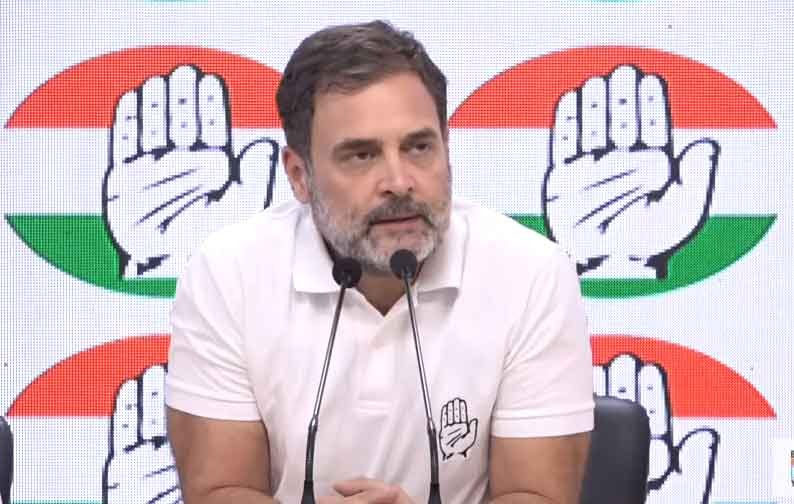
In a strongly worded statement, Congress MP Rahul Gandhi termed Trump’s 50% tariff hike as “economic blackmail”, aimed at coercing India into an unfair trade agreement. Gandhi accused the Modi government of compromising national interest for personal diplomacy and criticized the Prime Minister’s perceived weak response to an aggressive US trade stance.
“Trump’s 50% tariff is economic blackmail — an attempt to bully India into an unfair trade deal,” Rahul Gandhi said. “Prime Minister Modi should not let his weakness override the interests of the people of India.”
This sharp rebuke reflects a broader concern among opposition leaders that India’s current diplomatic strategy lacks the assertiveness required to defend economic interests in an increasingly protectionist global environment.
Jairam Ramesh Urges Modi to Channel Indira Gandhi’s Legacy
Congress General Secretary Jairam Ramesh invoked the legacy of former Prime Minister Indira Gandhi, urging Modi to emulate her uncompromising stance against external pressure. In a pointed message on social media platform X (formerly Twitter), Ramesh criticized the Prime Minister’s reliance on personal rapport with foreign leaders — particularly the optics of the ‘Howdy Modi’ event held in Houston in 2019.
“President Trump still calls himself a friend of Modi but is causing unfair and heavy damage to India. The tariffs he has imposed are not acceptable,” Ramesh wrote. “India had strongly faced the US’s bullying in the 1970s, especially under Indira Gandhi. Modi should leave his ego behind and understand how she presented India’s case firmly.”
Ramesh’s remarks reflect growing discontent within political circles over India’s foreign policy direction, particularly in dealing with global superpowers like the United States.
Shashi Tharoor Labels US Tariffs a “Setback” for Indian Exports
Shashi Tharoor, a seasoned diplomat and senior Congress leader, echoed similar concerns, calling the tariff hike a major setback for India. He highlighted the competitive disadvantage Indian exporters now face compared to neighboring countries like Vietnam, Indonesia, the Philippines, Bangladesh, and Pakistan, who are subject to significantly lower tariff rates.
“If the overall tariffs become 50%, our products will be too expensive in the American market. Why would US buyers choose Indian goods when similar products from other countries are cheaper?” Tharoor asked.
Tharoor emphasized the need to diversify India’s export destinations, pointing to ongoing talks with the European Union and the recently concluded Free Trade Agreement (FTA) with the United Kingdom as potential avenues for relief.
US Tariffs and Strategic Double Standards
Tharoor further called out the hypocrisy in US trade policy, pointing to Washington’s continued imports from China and Russia, even as it penalizes India for buying Russian oil.
“There is a clear double standard. The US has given China a 90-day exemption while China continues to buy more Russian oil than us. Meanwhile, India faces sanctions. This decision has come from a country we once considered a strategic partner.”
This perceived American inconsistency has sparked calls for a more assertive Indian trade response, including potential retaliatory tariffs on American imports.
The Failure of Modi’s ‘Hugplomacy’
Ramesh’s use of the term ‘hug-lome’ — a satirical jab at Modi’s diplomatic style of physical camaraderie with global leaders — underscores the belief that personal image-building has overtaken strategic policymaking. Critics argue that events like ‘Howdy Modi’ have done little to strengthen India’s negotiating position, and instead left the country vulnerable to unilateral economic measures.
During the Houston event in 2019, Prime Minister Modi broke with diplomatic tradition by openly endorsing Trump’s re-election campaign with the words, “This time, Trump Sarkar.” This unprecedented endorsement is now being viewed by opposition leaders as short-sighted and politically damaging, especially in light of the current trade conflict.
Aditya Thackeray Questions Government Silence
The US’s decision to impose a 25% additional tariff on India for purchasing Russian oil has also drawn criticism from Aditya Thackeray of the Shiv Sena (Uddhav Balasaheb Thackeray) faction. Thackeray questioned the lack of response from Union ministers, stating:
“Why is no minister answering this? Why are all the ministers silent? Is the trade agreement with the US still active?”
Thackeray’s questions underline the communication gap between the government and the public on issues of critical national interest. The absence of an official statement on the tariffs has fueled further speculation and concern.
Time for a New Foreign Policy Framework
The current situation has intensified calls for a complete overhaul of India’s foreign and trade policy apparatus. According to Jairam Ramesh, India must urgently reassess its international alignments, particularly as the global order undergoes significant shifts.
“Today there is a need for a comprehensive change in India’s foreign policy and administration. The world is no longer the same, and India must adapt with bold and clear strategy.”
This sentiment is echoed by policy experts and analysts who stress the importance of a resilient trade framework, strategic diversification, and independent decision-making in foreign affairs.
India’s Export Strategy Must Evolve
With rising tariffs, geopolitical instability, and protectionist trade environments becoming the new global norm, India must reconsider its export priorities and partnerships. Beyond established allies, newer economic partnerships must be explored, particularly in Africa, Latin America, Southeast Asia, and the Middle East.
Establishing bilateral FTAs, investing in logistics infrastructure, and incentivizing manufacturing exports will be critical to offset the negative impact of punitive tariffs from major economies like the US.
Conclusion: The Road Ahead for India
The imposition of tariffs by the United States has brought to light the fragility of personal diplomacy, the urgent need for strategic foreign policy, and the imperative of economic sovereignty. Voices from across India’s political spectrum are united in condemning Trump’s tariff policies and urging Prime Minister Modi to rise above personal diplomacy and act in the national interest.
As the global economic landscape becomes increasingly volatile and competitive, India must embrace a calculated, assertive, and principle-driven foreign policy — one that honors the legacy of leaders like Indira Gandhi, while steering the country confidently into the future.