November 3, 2025 | Global Economy Desk
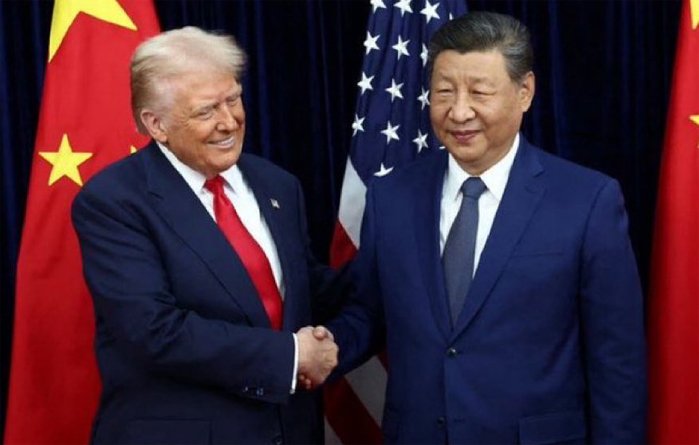
In a significant de-escalation of trade tensions, Washington has paused all planned 100% tariffs on Chinese goods for one year, while Beijing announced it will ease export curbs on rare earth minerals and end its investigation into U.S. semiconductor imports, signaling the strongest thaw in U.S.-China trade relations since 2019.
The twin moves sparked an immediate relief rally across global markets, particularly in semiconductor and manufacturing sectors that have faced prolonged uncertainty amid the world’s two largest economies’ trade standoff.
🇺🇸 Washington Freezes Tariffs — A Bid for Economic Calm
The White House confirmed late Sunday that the Biden administration would postpone implementation of the 100% tariffs on Chinese electric vehicles, batteries, and critical minerals originally scheduled for December 2025.
Officials cited “constructive progress” in recent bilateral discussions held in San Francisco and Beijing, aimed at building “a framework for balanced, rules-based trade.”
“The President believes this pause will give both nations breathing room to stabilize supply chains and support workers,” said U.S. Trade Representative Katherine Tai in a statement.
“We remain committed to defending American innovation while encouraging fair competition.”
The decision comes as U.S. inflation remains above 3% and consumer sentiment weakens — a combination that analysts say may have pushed Washington to cool trade tensions rather than risk higher import costs ahead of a politically sensitive winter.
🇨🇳 Beijing Responds by Lifting Curbs and Ending Chip Probe
China, in a reciprocal gesture, lifted restrictions on rare earth exports — materials crucial for EV batteries, magnets, and advanced electronics — and terminated its investigation into U.S. semiconductor firms, a probe that had stalled chip imports for months.
“China is committed to keeping global supply chains stable,” said Ministry of Commerce spokesperson He Yadong in a Monday press conference. “Dialogue and cooperation remain the only viable path forward.”
The end of the chip probe is particularly significant for U.S. semiconductor giants like Nvidia, Intel, and Qualcomm, all of which have faced regulatory bottlenecks in accessing China’s vast consumer and manufacturing base.
💹 Markets React Positively — Semiconductor Rally Leads
Wall Street futures jumped sharply in pre-market trading following the announcement. The Philadelphia Semiconductor Index (SOX) climbed nearly 3.5%, led by AMD (+4.2%), Nvidia (+3.9%), and Intel (+2.7%).
Asian markets mirrored the optimism — the Nikkei 225 rose 1.8%, Hang Seng added 2.2%, and Shanghai Composite gained 1.5%.
Analysts at JPMorgan forecast that if the trade détente holds through Q1 2026, it could lift the S&P 500 by 1–2% in the near term and reduce volatility in global supply chains.
“This is the first coordinated U.S.-China easing move in years,” said Richard Waters, global markets head at Morgan Stanley.
“It doesn’t resolve deeper strategic tensions, but it provides immediate relief to corporate confidence and logistics planning.”
⚙️ Supply Chains Get Breathing Space
The lifting of rare earth curbs could have far-reaching implications for global industries, particularly in electric vehicles, renewable energy, and defense technologies.
Rare earths such as neodymium and dysprosium are essential for motors and wind turbines, and China controls more than 60% of the global supply.
“The announcement removes one of the biggest choke points in global green tech,” noted Dr. Aditi Verma, a trade economist at the Indian Institute of Foreign Trade.
“Expect a temporary price correction in rare earth futures and a boost to clean-tech manufacturers.”
🌏 Geopolitical Overtones Remain
Despite the warming tone, both sides maintain a cautious posture. U.S. officials clarified that defense-related export restrictions and AI technology curbs remain firmly in place, while China reiterated its opposition to “weaponizing trade for strategic dominance.”
The truce appears tactical — designed to stabilize markets and manage inflation — rather than a long-term strategic realignment.
“This is détente by necessity, not trust,” observed Dr. Henry Lee, senior fellow at the Brookings Institution.
“Economic fatigue on both sides is driving this pause, but structural competition in technology and defense will persist.”
📊 Market Snapshot (as of 08:00 ET)
| Index | Latest | % Change | Trend |
|---|---|---|---|
| S&P 500 Futures | 5,032 | +1.2% | 🟢 |
| Nasdaq Futures | 18,950 | +1.6% | 🟢 |
| Dow Futures | 38,330 | +0.9% | 🟢 |
| Hang Seng | 18,420 | +2.2% | 🟢 |
| Gold | $3,975/oz | ▼ -1.3% | 🔻 |
| Oil (Brent) | $87.40/barrel | +0.5% | ➖ |
🧭 Editor’s Take:
This week’s U.S.-China announcements mark the most tangible easing in trade friction in nearly six years. While largely symbolic, the impact on global sentiment is real — especially for tech-heavy indices and supply chains stretched thin since the pandemic.
If both governments maintain diplomatic restraint, the 2025–26 period could see the return of modest global trade growth, benefiting exporters in Asia and manufacturers in the U.S. and Europe.
“Peaceful trade is profitable trade,” one market analyst quipped — and for now, investors seem inclined to agree.