Polling Underway Across Singapore in a High-Stakes Political Showdown
INVC NEWS Singapore — As the sun rose over Singapore this Saturday morning, more than 2.75 million registered voters began making their way to the 1,240 polling stations set up nationwide to cast their votes in the Singapore General Election 2025 (GE2025). With voting open from 8:00 AM to 8:00 PM, the nation braces for one of its most consequential elections in recent memory.
This year, 92 out of 97 parliamentary seats are being contested, while the People’s Action Party (PAP) has already secured five seats unopposed, showcasing its enduring political clout. A total of 211 candidates representing 11 political parties and 2 independent candidates are vying for the trust of the electorate.
Lawrence Wong Eyes Renewed Mandate Amid Domestic and Global Pressures
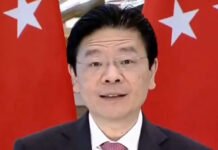
Prime Minister Lawrence Wong, who took office less than a year ago following Lee Hsien Loong’s retirement, is now seeking a strong electoral mandate to solidify his leadership. His party, the PAP, has ruled Singapore uninterrupted since its independence in 1965 and is widely credited with transforming the island nation into a global economic powerhouse.
However, the road to victory in 2025 is not without obstacles. Soaring inflation, skyrocketing housing prices, and rising discontent over foreign labor policies have emerged as dominant voter concerns. These domestic pressures, paired with external economic threats, have shaped a complex electoral environment.
Economic Woes: Tariff Turmoil and Trade Headwinds Challenge Stability
Compounding domestic challenges is the recent reintroduction of U.S. tariffs under the Trump administration, a move that threatens to undermine Singapore’s export-driven economy. With the United States being Singapore’s top trading partner, any disruption in trade dynamics poses a significant risk to the nation’s economic outlook.
Singapore’s economy, long reliant on its reputation as a stable and transparent business hub, now faces uncertainties as geopolitical tensions and trade realignments take center stage. The government’s handling of these issues—especially by Prime Minister Wong—will undoubtedly be scrutinized in the aftermath of today’s vote.
Opposition Gains Momentum, Targets Key Urban Constituencies
In a clear signal of growing political diversification, opposition parties have mounted a significant challenge this year. The Workers’ Party (WP) has fielded candidates in 26 constituencies, including pivotal battlegrounds such as Aljunied GRC and Sengkang GRC, which it currently holds.
The Progress Singapore Party (PSP), founded by former PAP stalwart Dr. Tan Cheng Bock, is contesting 13 candidates across six GRCs, focusing on expanding its foothold beyond West Coast GRC.
Other parties in the fray include:
Singapore Democratic Party (SDP)
Singapore People’s Party (SPP)
People’s Power Party (PPP)
Reform Party (RP)
Red Dot United (RDU)
National Solidarity Party (NSP)
Singapore United Party (SUP)
Singapore Democratic Alliance (SDA)
Together, these parties represent a broad spectrum of ideologies, each aiming to challenge the PAP’s dominance with fresh narratives focused on social justice, housing reforms, and income equality.
Voters Abroad Also Cast Ballots in Record Numbers
Ahead of today’s main event, over 18,000 overseas Singaporeans have already exercised their franchise in cities including Dubai, London, New York, Washington, and San Francisco, starting from May 2. This reflects a growing enthusiasm among the global Singaporean diaspora, many of whom remain deeply invested in the country’s governance.
Security and Logistics: A Smooth Electoral Process
The Elections Department of Singapore (ELD) has confirmed that extensive measures have been implemented to ensure a smooth, secure, and efficient polling process. Each polling station is equipped with:
Real-time electronic voter verification
Enhanced cybersecurity protocols to protect voter data
Lines moved steadily throughout the morning, with officials reporting high turnout by midday. Voting remains mandatory in Singapore, with fines applicable for unjustified absenteeism.
Key Battle Zones to Watch in GE2025
While the PAP maintains a stronghold in many areas, several hotly contested constituencies may define the political narrative tonight:
Aljunied GRC: Long held by the WP, this area is expected to witness a fierce showdown as PAP looks to reclaim the seat.
Sengkang GRC: A newer WP stronghold that has become a symbolic test of opposition staying power.
West Coast GRC: PSP aims to make inroads here after coming close in 2020.
These constituencies are not just battlegrounds—they are bellwethers for broader public sentiment regarding governance, accountability, and economic stewardship.
Why This Election Matters Beyond Singapore’s Borders
Singapore’s election is not just a national affair. It holds global economic implications, especially for companies that operate across Asia-Pacific markets using Singapore as their regional headquarters. Any political instability or significant shift in policy direction could have a ripple effect across international financial markets.
Furthermore, regional neighbors and global powers will be closely monitoring the outcome, given Singapore’s strategic role in Southeast Asia, particularly in maritime trade, finance, and regional security.
Counting Begins Tonight, Results Expected Late Evening
As voting concludes at 8 PM, official counting will begin immediately, with preliminary results expected by late Saturday night. All eyes will be on the PAP’s final tally—whether it retains its traditional two-thirds parliamentary supermajority or faces reduced margins that could empower a more vocal opposition in Parliament.
The Election Department has assured a transparent and accurate counting process, with public announcements to be made via official government channels and live televised updates.
The Verdict Awaits: A Nation on Edge
As Singaporeans cast their votes today, the question looms large: Will the nation continue its legacy of stable, one-party dominance, or is this the dawn of a more pluralistic political future?
Prime Minister Lawrence Wong’s ability to navigate a complex landscape of economic uncertainty, social dissatisfaction, and global challenges hangs in the balance. By tonight, the answer will become clear.
One thing remains certain—this election is not just about choosing representatives; it is a referendum on Singapore’s path forward in a world full of shifting tides.