New Delhi, October 31, 2025:
India’s growing battle against air pollution has taken a grim turn. According to the latest Lancet Countdown on Health and Climate Change (2025), nearly 70% of global air pollution–related deaths are now linked to India — making it the epicentre of the world’s air-quality crisis.
The study, which examined data from over 180 countries, estimates that 1.72 million Indians die annually due to anthropogenic air pollution, particularly exposure to fine particulate matter (PM₂.₅). That’s a 38% increase since 2010 — a rate faster than almost anywhere else in the world.
🌫️ India: The World’s Pollution Hotspot
The report highlights that while global air pollution deaths declined slightly due to improved regulations in Europe and the Americas, India and South Asia saw a dramatic spike.
The worst offenders are PM₂.₅ particles — tiny but deadly — produced from burning coal, crop residue, vehicular emissions, and industrial output. Once inhaled, these microscopic pollutants penetrate deep into the lungs and bloodstream, causing strokes, heart disease, and respiratory failure.
“Air pollution in India has become a public health emergency on the scale of the pandemic,” said Dr. Elizabeth Friel, one of the lead authors of the Lancet report. “The crisis is now both environmental and economic.”
📉 The Numbers Behind the Tragedy
1.72 million annual deaths directly linked to air pollution in India
40% of those deaths associated with PM₂.₅ from fossil fuel combustion
₹2.9 lakh crore estimated annual productivity loss due to illness and absenteeism
Over 85% of Indians breathe air that exceeds the WHO’s safe limit by five times
Even smaller towns once considered clean — such as Dehradun, Patna, and Nagpur — are now reporting PM₂.₅ levels 10–15 times above safe thresholds.
🏙️ Delhi: Still the World’s Most Polluted Capital
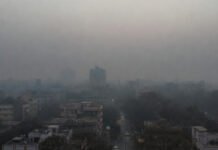
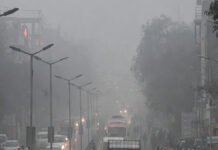
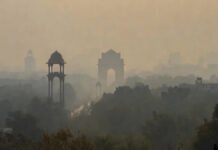
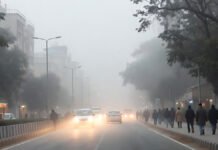
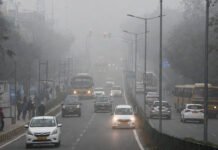
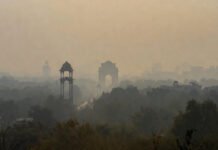
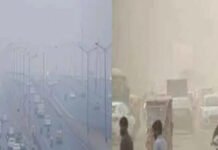
Delhi continues to hold the unenviable record as the most polluted capital city on Earth. October’s AQI has already reached “Severe” levels (over 400) on multiple days.
“When you walk outside, it feels like inhaling burnt rubber,” said Rohit Sharma, an IT professional from Noida. “It’s impossible to breathe without coughing.”
A study by The Energy and Resources Institute (TERI) suggests that air pollution in Delhi alone shortens the average life expectancy by 9.5 years.
⚡ The Climate Connection
The Lancet report goes beyond health to link air pollution with climate vulnerability. India’s dependence on coal and diesel fuels both global warming and local pollution.
Rising temperatures are also amplifying the problem. Hotter conditions trigger ozone formation at ground level, compounding respiratory risks. Meanwhile, erratic rainfall patterns reduce the natural “washing” of pollutants from the atmosphere.
“India’s pollution crisis is also its climate crisis,” noted Dr. Roxy Mathew Koll, climate scientist at IITM Pune. “Our future depends on cleaner energy transitions, not temporary fixes like air filters.”
🏗️ Government Efforts — Progress, but Not Enough
India has taken several steps in recent years:
Implementation of the National Clean Air Programme (NCAP) in 131 cities
Push for electric vehicles under FAME-II scheme
Gradual phasing out of coal plants in urban peripheries
Strict enforcement of construction-dust and stubble-burning controls
However, implementation gaps remain. Many states lack real-time monitoring systems, and inter-state coordination is weak.
“Policy is there, intent is there — but enforcement is the missing link,” said Sunita Narain, Director-General of the Centre for Science and Environment.
🧠 Solutions & The Road Ahead
Experts call for an integrated approach combining technology, policy, and behavioural change:
Transition to renewable energy — solar, wind, and green hydrogen.
Strengthen urban planning to include ventilation corridors and green buffers.
Subsidise public transport and tax high-pollution vehicles.
Enhance indoor air quality awareness — pollution doesn’t stop at the window.
Cross-border coordination across northern states for stubble management.
“Air pollution is solvable,” insists Dr. Arvind Kumar, lung surgeon and founder of the Lung Care Foundation. “But only if we treat it as a health emergency, not a seasonal inconvenience.”
💔 The Human Face of the Crisis
Children, the elderly, and those with chronic illnesses remain most vulnerable. Schools in NCR have repeatedly closed this season due to hazardous AQI levels.
Parents now send kids to school with masks, and doctors warn of a spike in asthma cases among toddlers.
“We’re raising a generation that has never known clean air,” lamented Meera Bansal, a Delhi mother of two.
🌍 Conclusion
The Lancet report is a wake-up call — not just for India, but for the planet. As the world’s fastest-growing major economy, India stands at a crossroads: continue its fossil-fuel-driven growth or lead the transition to clean air and sustainable energy.
Until then, the air that fuels India’s economic engine may also remain its silent killer.